

| Client | Brianna Bancroft, CEO |
| Sector | Real Estate - UK |
| Regulatory | FCA Appointed Representative Framework |
| Challenge | Translating existing compliance obligations into a functional token architecture |
| Solution | Custom ERC-3643 platform with on-chain investor eligibility enforcement |
| Outcome | 6 months. Zero investments. Zero manual checks. |
The Situation
Brianna Bancroft wasn't new to real estate. She wasn't new to regulation either.
As the CEO of a UK-based real estate investment firm operating under the FCA's Appointed Representative framework, Brianna had already navigated one of the more demanding compliance environments in European finance. Her firm knew who its investors were. They knew which checks were required. They had legal obligations, documented processes, and a reputation built on doing things correctly.
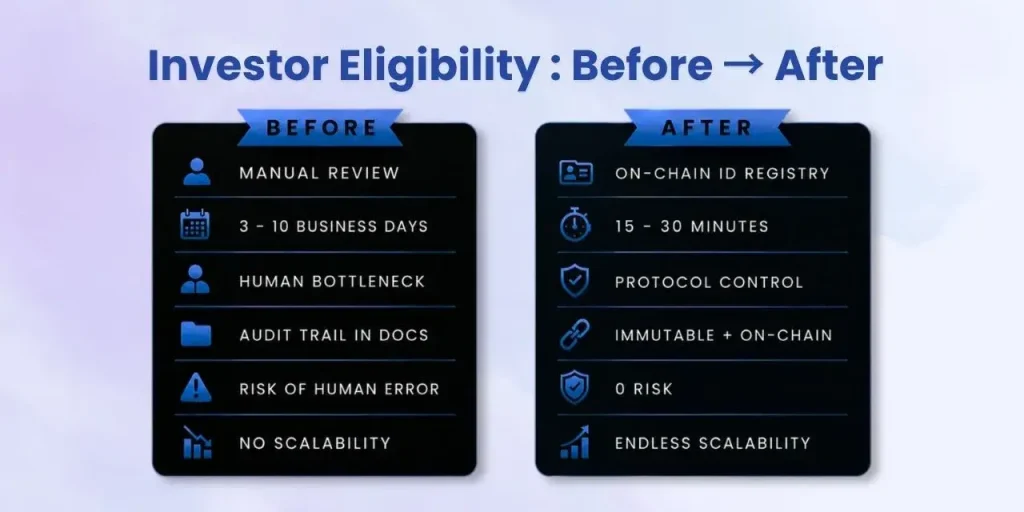
Brianna's firm was already doing the investor checks, documented eligibility reviews, and careful KYC records. But doing them manually meant investor onboarding took between 3 and 10 business days per person, every time. The cap table was reconciled periodically, not in real time. And every eligibility decision lived in a document, not in an enforced system.
As the firm began evaluating a broader, fractionalized investor offering, the arithmetic stopped working. More investors meant more manual reviews. More manual reviews meant more compliance overhead. And what they calculated was that the operational model that worked at 20 investors wasn't going to hold at 200.
Their question was whether tokenization could preserve compliance by removing the manual mechanism that was blocking its growth.
The UK tokenized real estate market was accelerating. By early 2025, 46% of real estate firms globally were either piloting or actively evaluating tokenization. For Brianna, the appeal was clear: fractional ownership opens your investor base, automated distributions reduce operational overhead, and on-chain cap tables remove reconciliation errors entirely. The opportunity was real. But so was the risk.
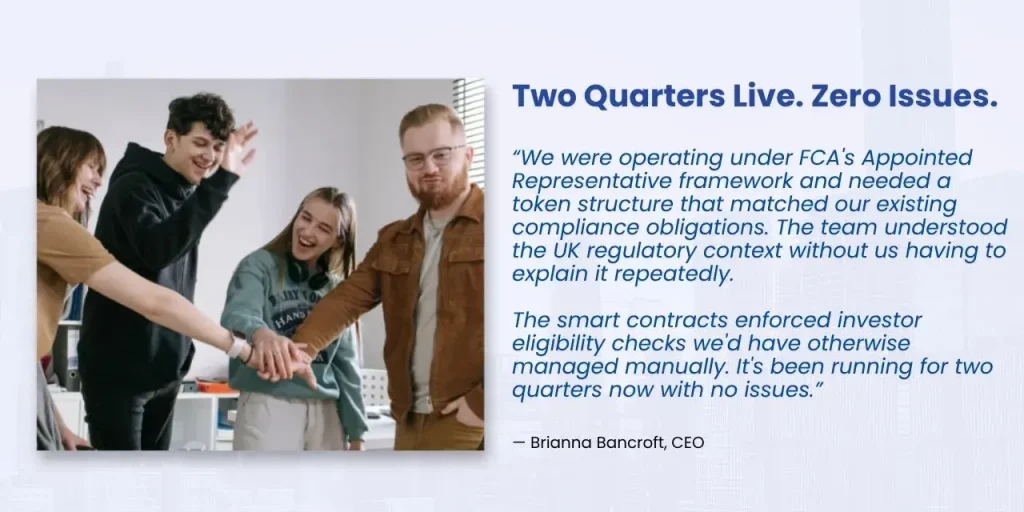
"We were operating under FCA's Appointed Representative framework and needed a token structure that matched our existing compliance obligations." — Brianna Bancroft, CEO
The Regulatory Situation
The FCA's AR regime is specific. Investor eligibility isn't a suggestion — it's a gatekeeping requirement that carries legal liability for the principal firm. Walking into tokenization without ensuring that a gate existed on-chain, enforced automatically, would have been a structural compliance failure from day one.
One further development made the timing right. The Property (Digital Assets etc) Act 2025 confirmed that digital assets constitute a recognised third category of personal property under English law. A token representing SPV interests is now enforceable as property in English courts, removing the legal ambiguity that had complicated UK tokenization structures before the Act was passed.
The Task
Brianna just doesn’t need an RWA tokenization platform. She needed an architecture that doesn’t leave their compliance framework. Technically, what their Real Estate business demanded was smart contracts that would enforce investor eligibility criteria. That’s the same criteria the team had previously managed through manual review workflows in automation.
Technical Breakdown
Whitelist Architecture tied to FCA AR-aligned investor categories (professional/sophisticated/high-net-worth distinctions)
On-chain Identity Verification that mapped to KYC/AML outcomes already produced by her compliance workflow
Transfer Restriction Rules that enforced eligibility status at every transaction
No change to their Legal Structure, the SPV, the AR relationship, and the documentation to remain intact.
Manual investor eligibility review and KYC process consumes a large amount of time, typically between 3-10 business days per investor. This creates a major hindrance in onboarding investors. Our task is to remove that hindrance without breaking the compliance architecture.
The stakes of getting this wrong were not abstract. Under the FCA AR regime, investor eligibility errors don't stay internal, they become the principal firm's liability. A single transfer to an ineligible investor is a breach of the AR agreement. At scale, manual review doesn't just slow the business down. It creates a compliance surface that grows with every investor added, and one that no amount of documentation can fully close.
"We were doing everything right. The checks, the records, the documentation. But we knew that as soon as we started scaling the investor base, the manual process would break before the compliance framework did." — Brianna Bancroft, CEO
The Action: Mapping FCA Obligations to On-chain Logic
Phase #1 Compliance Specification
Before the development, the Compliance Specification Document was created. This is the blueprint that translated the client’s existing FCA AR obligations into technical architecture for the smart contract suite.
The compliance specification document had defined,
- Which investor categories were eligible, and how they’d be whitelisted
- Which jurisdictions were in or out of scope for the offering
- Lock-up periods and secondary market access conditions
- How forced transfers and wallet recovery would work under UK legal requirements
Brianna’s legal counsel and development team worked from the same document. So, there was no confusion between the legal entity and technical implementation.
Phase #2 ERC3643 Token Architecture
The RWA platform was built on the ERC-3643, which is the compliance-native security standard. For our client’s use case, we configured it to
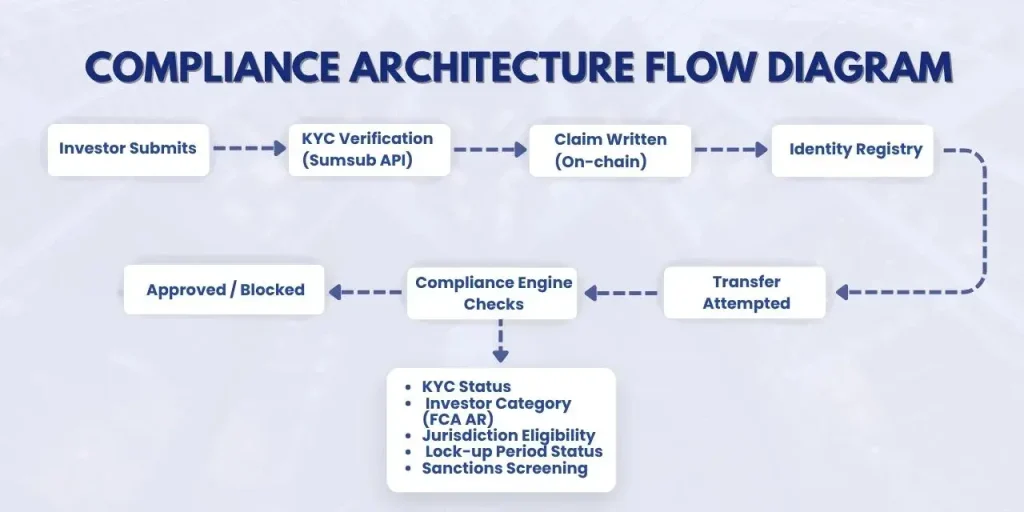
- Enforce investor eligibility on-chain using a permissioned identity registry
- Block unverified wallets at the protocol level - no eligibility claim, no token transfer
- Stack compliance modules for their specific rules like UK jurisdiction-based FCA registration.
Phase #3 Automated Eligibility Engine
The investor onboarding flow is connected to the KYC providers like Sumsub through API. This architecture fulfilled the firm's obligations under the UK Money Laundering Regulations 2017 (MLRs). Once a verification was completed off-chain, the result was written as the signed claim to the investor’s on-chain identity. The token contract reads that claim automatically on every transaction.
The result acquired,
Investor eligibility verification, which previously required manual review, was then reduced to a 15-30 minute automated verification.
The Re-KYC Scheduler was configured to monitor claim expiry and trigger a re-verification request automatically. This was the critical feature of the client’s FCA AR context, where investor status cannot be assumed to be permanent.
Phase #4 Security Audit
Before Brianna's first investor onboarded, the platform had already been through a full security audit. The smart contract suite went to an independent firm before handover. Every critical, high, and medium finding was resolved and re-audited.
The clean report went into the platform’s investor vault, visible to every verified investor from day one. Before the external review, the platform ran through over 100 internal test scenarios. Every financial function had 100% test coverage. The platform shipped clean with the transparent audit report.
The Result: 6 Months 0 Issues
Brianna’s RWA tokenization platform has been operational for two quarters. And here’s what Brianna says,
"The smart contracts enforced investor eligibility checks we'd have otherwise managed manually. It's been running for two quarters now with no issues." — Brianna Bancroft, CEO
Here’s what no issues mean in measurable terms.
What Brianna’s Story tells other Real Estate Operators
The most common misconception about tokenization is that it requires replacing your compliance framework with a blockchain-native one.
Brianna’s case is the counter-argument. She brought an existing, FCA-regulated compliance structure, and the platform was built to encode it. The result is a tokenization infrastructure that satisfies both the regulator and the investor without having to compromise.
One thing that I surely put forth for real estate operators who wish to build their tokenization platform inside the regulated environment. InnBlockchain guarantees deliberate transparency throughout your Real world asset tokenization platform development to launch.
Reach us to create your custom RWA tokenization platform of any asset with 100% compliance and security.