
You own the asset. You understand the market. But the moment you decide to tokenize it, put it on-chain, and allow investors to hold fractional ownership, you enter a compliance architecture that most Web3 developers and lawyers have never had to navigate simultaneously.
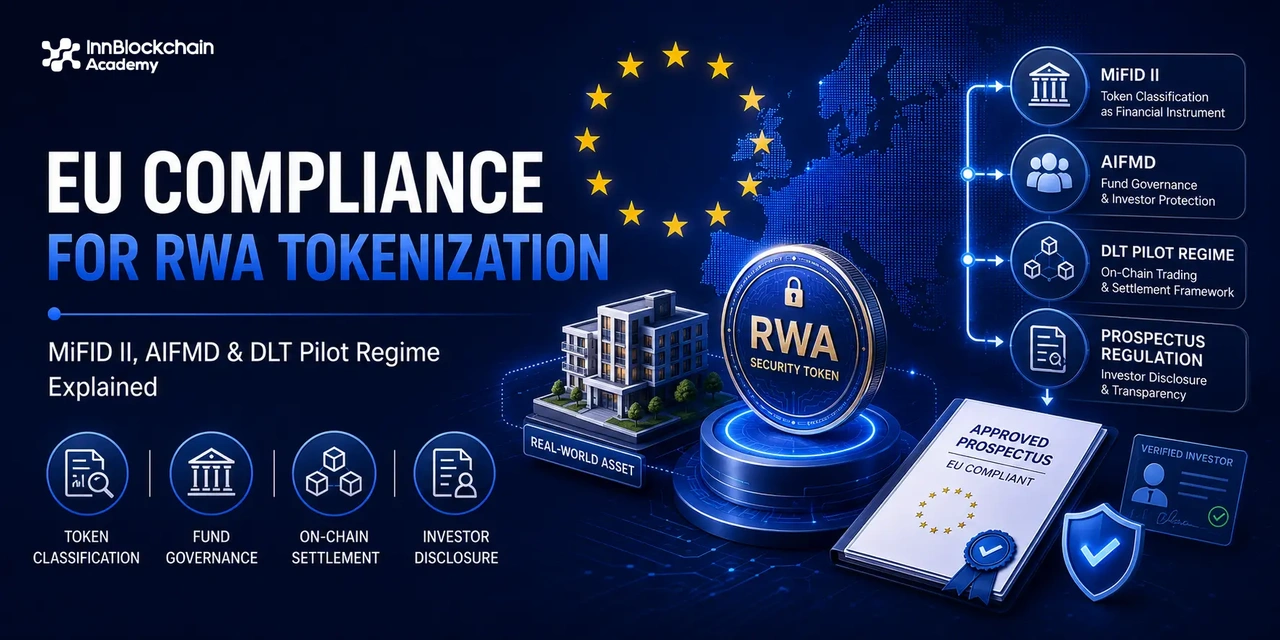
The EU has not created a single regulation for RWA tokenization. It has created several, and each one governs a different layer of what you are building:
- MiFID II determines what your token legally is, namely a financial instrument with trading, reporting, and transfer rules attached.
- AIFMD determines how the fund behind the token must be managed if your structure pools investor capital.
- The DLT Pilot Regime determines where and how the token can legally trade and settle on-chain.
- Prospectus Regulation determines what you must publicly disclose before distributing your token.
If you miss any one of these, your platform is not "mostly compliant." It is non-compliant, exposing you to NCA enforcement actions, investor litigation, and exchange delisting.
This article explains the complete criteria and checklist on EU compliance for RWA tokenization and how all four fit together into a single architecture.
Note: This article is research work that is solely for EU and EEA asset owners and holders and EEA countries.
The Classification Decision
Every real-world asset you tokenize first goes through this test, named “MiFID Instrument Test”. This is to determine whether your asset is a financial instrument. This is the stage where your compliance path for RWA tokenization is decided. And it follows your licensing, disclosure, and trading rules.
What is MiFID II?
Markets in Financial Instruments Directive II is a massive set of rules that governs the European financial market. Its ultimate goal is to protect investors and keep the market fair and unbiased. MiFID II Annex I, Section C lists 11 financial instrument categories in full. For RWA tokenization, three categories are the most commonly encountered triggers.
Note: A Directive sets minimum standards that each EU member state must transpose into national law, unlike a Regulation, which applies identically across all 27 member states the moment it enters into force. This means MiFID II, AIFMD have slight variation among countries.
The Three Most Relevant Categories for RWA Tokenization
- C1 - Transferable Securities - Standard investments. Eg: Shares, Bonds, Equity
- C2 - Money Market Instruments - Short-term debt instruments. Eg: Treasury Bills, Certificates of Deposit(CDs), and Commercial Paper
- C3 - Units in Collective Investment Undertakings - Investment funds. Eg: Mutual funds, Alternative investment funds(when pooled their money together)
The remaining categories cover derivatives (C4-C10), emission allowance (C11), and commodity instruments that are relevant only in specific structures.
So, what does it all say?
Does your token represent a claim, right, or economic interest that maps onto one of these three instrument types?
If YES, the issuer, the platform, and the intermediaries must comply with MiFID II.
If NO, it may fall under other regimes like MiCA or its national law.
The consequences of classifying incorrectly under MiCA
When it comes to tokenizing a real-world asset in the EU region, businesses always think MiCA is the regulatory path to be followed.
But in Art2(4), MiCA explicitly states that if a token qualifies as a financial instrument, then MiCA does not apply, and it goes straight under MiFID II.
As a result,
- You'll face regulatory enforcement actions, fines, and potential licence revocation
- Investors can easily sue you
- Exchanges will delist your token
And another one of the biggest misunderstandings is that they think that only one regulation covers all and is more than enough for moving their assets on-chain. Tokenization involves a bundle of regulations for each purpose. And the sole purpose of these is to protect investors' funds at any cost.
MiFID II alone won’t solve your tokenization. AIFMD, DLT Pilot Regime, and Prospectus Regulation are the missing pieces of your puzzle.
- MiFID II decides what your token is(Financial Instrument)
- AIFMD dictates who manages your funds behind it(Fund Managers)
- DLT Pilot Regime dictates where and how the token can be legally traded(sandbox)
- Prospectus Regulation dictates what you must publicly disclose before your token reaches any investor(public disclosure)
Note: Regulatory classification depends entirely on your token's purpose and structure. A token pegged 1:1 to a fiat currency or a commodity basket with no ownership claim falls under MiCA, not MiFID II. This article covers the common case of a token that confers ownership, generates a return, or represents a legal claim on a real-world asset. These qualify as transferable securities and fall under MiFID II.
In industry terminology, the issuance of such tokens to investors constitutes a Security Token Offering (STO). Every compliance obligation this article covers applies to any RWA-backed STO operating in the EU.
Now let’s get to the primary regulatory layer in detail.
Before diving in, here's the complete EU compliance architecture at a glance.

Each regulation is explained in detail below. Use this diagram as your reference map.
MiFID II: The One-Master Regulation for RWA Tokens
MiFID II is the master rulebook for financial markets in the EU region. It entered into force in 2014 and has applied across the EU from 3 January 2018, replacing MiFID I (2004/39/EC), which applied from 2007. MiFID II doesn’t interfere with the technology. It imposes functional requirements that must be integrated into the smart contract layer.
MiFID II is built around three core goals.
- Investor Protection to ensure all the investors are treated fairly and get the best execution.
- Market Transparency, which demands that all trades must be reported and visible to investors
- Market Integrity to prevent manipulation, conflicts of interest, and illegal trading.
Eligibility Criteria for MiFID II
Does your token qualify as a MiFID II financial instrument? (The Classification Test)
- Your token represents ownership of a real-world asset (real estate, equity, private debt, infrastructure)
- Your token generates a yield, dividend, or return for the holder
- Your token gives the investor a legal claim on an asset or its proceeds
- Investors can buy, sell, or transfer your token to others
Does your platform need MiFID II investment-firm authorization? (The Authorization test)
MiFID II investment-firm authorization (Art 5) is triggered by your platform's activity, not just your token's features. A pure issuer who mints tokens and conducts a primary offer only with no secondary trading, no order execution, no portfolio management does not need MiFID II authorization. Prospectus Regulation and MAR may still apply. Authorization is required only when you receive/transmit orders, execute trades, operate an MTF/OTF, or manage portfolios.
What MiFID II is actually asking you to do
- Every investor must be identified and verified before they can hold your token.
- Their assets must be held separately from your company's assets at all times.
- Every trade must happen at the best available price. You cannot route orders to a worse price simply to generate additional fees.
- Every trade must be reported to the regulator by the next business day, including the full legal identity of both parties. (MiFIR Art 26)
- Every transfer must be checked against a ruleset covering eligibility, jurisdiction, and sanctions before it executes.
- Every trade must settle atomically, meaning the token and payment are exchanged in a single transaction rather than in two separate steps. (CSDR Art. 5 — and from 11 October 2027, the T+1 mandate under Regulation (EU) 2025/2075 applies)
MiFID III update (June 2026): If your platform operates a DLT Pilot trading venue or acts as a systematic internaliser, two new obligations apply from June 2026.
- The consolidated tape — your venue must contribute trade data to the EU-wide feed.
- The PFOF ban — you cannot receive payment from a market-maker in exchange for routing client orders their way. Pure issuers are unaffected.
But if your token pools investor capital into a shared structure, a real estate SPV, an infrastructure fund, a VC vehicle, then MiFID II's six layers are only the foundation. An entire second regulation governs how that fund must be managed, and it comes with its own smart contract requirements.
Let’s see it.
AIFMD Requirements for Tokenized Fund Structures
We know that MiFID II governs how the tokens are to be traded, reported, and transferred. But if your token is structured as a pooled fund, it becomes a fund, and AIFMD is definitely your first legal consideration for your tokenization.
AIFMD is the Alternative Investment Fund Management Directive that governs any collective investment undertaking that
- Raises capital from multiple investors
- Invests the capital according to a defined investment policy
- For the benefit of those investors
- It is not a UCITS fund (Directive 2009/65/EC), and does not fall within AIFMD's Article 2(3) exclusions — importantly, a passive RWA holding company returning asset yield to investors will not satisfy the holding-company carve-out under ESMA's Guidelines on key concepts of the AIFMD, and will be treated as an AIF.
Eligibility Criteria for AIFMD
AIFMD applies to you if any one of them resembles your token’s purpose.
- Multiple investors are putting money into a shared pool
- That pooled money is used to buy assets (real estate, private equity, infrastructure, private credit)
- Investors receive a return based on how the pool performs
- A manager makes investment decisions on behalf of that pool
For most RWA tokenization platforms, UCITS does not apply. UCITS is restricted to open-ended funds holding liquid assets(listed shares, bonds) and targeting retail. Illiquid assets like real estate, private equity, and infrastructure push you automatically into the AIFMD path.
Your Simple Trigger Test 📋
- All boxes checked; AIFMD applies on top of MiFID II.
- Each investor owns a direct, individual fractional share of a single asset with no pooling and no fund manager; AIFMD does not apply. Skip to the DLT Pilot Regime section.
Sub-threshold note: If your AUM* is below the thresholds (below €100M for leveraged funds or below €500M for unleveraged, closed-ended funds†), AIFMD’s full authorization requirements don’t apply. But you’re still required to register with your home regulator (Art 3(3)). You get lighter obligations, but you also lose the EU-wide marketing passport. You can voluntarily opt into full authorization (Art 3(4)) to unlock the passport.
*AUM - Assets Under Management
†Closed-ended funds - Funds that can’t be withdrawn on demand
Above all, you need to know that AIFMD and MiFID II are not alternatives. They are layers that work together with different goals and purposes.
| Dimension | MiFID II Governs | AIFMD Governs |
|---|---|---|
| What it regulates | The token as a financial instrument | The fund behind the token |
| Who it regulates | Investment firms that trade/distribute the token | The fund manager that operates the structure |
| Investor Protection | Best execution, suitability, transfer rules | Depositary oversight, valuation accuracy, leverage limits |
| Custody | Segregation of client assets | An independent depositary must safeguard all fund assets |
| Reporting | Trade reports to ARM(RTS 22) | Fund-level reports to NCAs(Annex IV reporting) |
| Transparency | Pre and post-trade transparency | Full fee disclosure, risk profile, investment strategy |
So, what's the take?
Both are brought to protect investors, but in different departments.
MiFID II protects investors when they trade the token.
AIFMD protects the investor from how the fund manager runs behind it.
Note: The fund units are MiFID II financial instruments (C3), so firms that trade or distribute them face MiFID II conduct rules. The fund manager is authorised under AIFMD, which expressly excludes the AIFM from MiFID II authorisation for portfolio management (Art. 2(1)(b)). They are complementary layers: one governs the instrument, the other the manager.
What AIFMD is actually asking you to do
- Your fund manager must be licensed as an AIFM by the home-state NCA before a single investor can be onboarded. (AIFMD Art. 6)
- An independent depositary must be appointed to safeguard all fund assets. The depositary cannot be the same entity as the AIFM. (AIFMD Art. 21)
- Every fund asset must be valued independently — the manager cannot self-certify NAV. Valuation must follow a documented methodology and be reviewed at least annually. (AIFMD Art. 19)
- Full fee disclosure, risk profile, and investment strategy must be published in a pre-investment disclosure document before any investor commits capital. (AIFMD Art. 23)
- For open-ended funds: at least two liquidity management tools — such as redemption gates and notice periods — must be programmed directly into the smart contract and activated proportionate to the fund's liquidity profile. (AIFMD II, Annex V — mandatory from 16 April 2026)
- Fund-level data must be reported to your NCA annually using the Annex IV template, covering AIF identity, investment strategy, leverage, and risk. (AIFMD Art. 24)
Why ELTIF 2.0 matters for RWA asset owners?
ELTIF 2.0 (Regulation (EU) 2023/606, in force from January 2024) is the most commercially significant wrapper for RWA tokenization platforms that want to reach retail investors. ELTIF (European Long-Term Investment Funds) is a regulated packaging that makes alternative investments accessible beyond just professional/instituitional investors. Without it, your AIF is restricted to professional investors, which are typically institutions and high-net-worth individuals with at least €500,000 in investable assets.
ELTIF 2.0 removed the previous minimum €10,000 investment threshold for retail investors and the prior requirement that retail investors have a portfolio exceeding €500,000. This makes it the primary route for tokenized real estate funds, infrastructure funds, and private credit funds to access a broader EU retail investor base.
Real Estate Tokenization Case Study: Click to Read
These two regulations together combine to give a complete compliance architecture for tokenized funds operating in the EU.
But where does the trade actually settle?
Traditional finance uses CSD and your blockchain replaces it. To fill this regulatory gap, the DLT Pilot Regime is required.
DLT Pilot Regime: On-chain Settlement Infrastructure
Your RWA token is a financial instrument under MiFID II (it confers ownership of a real asset). Financial instruments need two things to function in a regulated market.
- A trading venue where buyers and sellers match (governed by MiFID II — traditionally an MTF)
- A settlement system where ownership officially transfers (governed by CSDR — traditionally a CSD like Euroclear)
In traditional finance, these are separate entities run by separate licensed operators. Trading venues are licensed under MiFID II while settlent is governed by CSDR, creating a structural separation between the two functions.
On a blockchain, your smart contract does both. It matches the trade and records the transfer. One system, one ledger, one transaction.
The DLT Pilot Regime (Regulation 2022/858, live since 23 March 2023) is the EU's regulatory sandbox that legally permits this. Allowing DLT-based infrastructure to trade and settle tokenized financial instruments on-chain, with specific exemptions from MiFID II and CSDR rules that would otherwise make it illegal.
Eligibility Criteria for DLT Pilot Regime
DLT Pilot Regime applies to you if any one of them resembles your token’s purpose.
- You want investors to be able to buy and sell your token on a secondary market after the initial issuance
- That secondary market will run on a blockchain (on-chain trading and settlement)
- You need the ownership transfer to be legally final and recorded on-chain
The Three Infrastructure Types
| Type | What it does | Traditional Equivalent | Relevance for RWA |
|---|---|---|---|
| DLT MTF | Trades tokenized instruments on DLT | Multi-lateral Trading Facility | Partially Relevant |
| DLT SS | Settles and records ownership on DLT | Central Securities Depository | Partially Relevant |
| DLT TSS | Trades and settles on a single DLT | MTF+CSD Combined | Completely Relevant |
Note on thresholds: The per-instrument cap is €500M (shares / UCITS units) or €1B (bonds and other securitised debt). The aggregate cap for any single DLT infrastructure, including DLT MTF, DLT SS, and DLT TSS, is €6 billion at the moment of admission. If the total exceeds €9 billion, the mandatory transition strategy must be activated. The European Commission's Market Integration and Supervision Package (MISP), published 4 December 2025, proposes raising this limit to €100 billion, but the proposal is still in trilogue negotiations and is not expected to enter into force before 2027.
Critical authorization condition: The mandatory transition strategy your documented plan for migrating or winding down operations if the sandbox expires or you exceed the €9B trigger must be completed and submitted before you receive DLT Pilot authorization. It is not a future planning exercise. Build it before you apply.
What DLT Pilot Regime is actually asking you to do
- You must apply for DLT Pilot authorization from your home NCA before operating any on-chain trading or settlement venue. (Reg 2022/858, Art. 8 / 10 / 12)
- A mandatory transition strategy — your documented plan for winding down or migrating to a conventional venue if the sandbox expires or your aggregate cap is breached — must be completed and submitted as part of the authorization application, not after. (Art. 7(7))
- Your smart contract must enforce per-instrument admission caps: €500M for shares and UCITS units; €1B for bonds and other securitised debt. Admitting an instrument above its cap is a breach of authorization conditions. (Art. 3)
- Your infrastructure must track aggregate DLT market value in real time. At €6B, you are at the admission limit. At €9B, the transition strategy activates automatically. (Art. 3(3))
- Every transfer of ownership must be settled with finality on-chain — legally irrevocable and recorded on the DLT ledger. From 11 October 2027, the T+1 settlement mandate (Reg 2025/2075) applies. (CSDR Art. 5 as applied by exemption)
- If you operate a DLT Pilot trading venue, your system must emit trade data to the MiFID III consolidated tape from June 2026. (MiFID III, Reg 2024/791)
Prospectus Regulation: Disclosure Requirements Before Your Token Launch
MiFID II classifies your token. AIFMD governs the fund structure behind it. The DLT Pilot Regime provides the On-chain settlement rails for both. But before a single token reaches an investor, one more regulation controls what you must publicly disclose and what your smart contract must enforce.
The Prospectus Regulation (EU) 2017/1129 requires any public offer of transferable securities in the EU to be accompanied by an NCA-approved prospectus, unless an exemption applies.
When you need one, and when you don't
A full prospectus is required when your public offer exceeds €12 million over a 12-month period.
From 5 June 2026 (EU Listing Act, Reg 2024/2809), the prospectus obligation threshold is unified at €12M per issuer/offeror over 12 months, below which non-passported offers are exempt.
Note: Member States may elect a lower €5M floor. The legacy €8M structure applies to offers launched before 5 June 2026.
You may qualify for an exemption if
- The offer total remains below €12 million (the unified threshold from 5 June 2026, Reg 2024/2809). Some Member States may elect a lower floor down to €5 million, so verify your NCA's local rule. Offers launched before 5 June 2026 remain governed by the legacy €8M threshold.
- The offer is restricted entirely to qualified investors.
- The offer is made to fewer than 150 persons per member state.
Under an exemption, you still need a compliant disclosure document, but it does not require NCA approval.
A platform with DLT Pilot approval but no NCA-reviewed prospectus cannot legally offer tokens to the public. Start the prospectus process 3–6 months before launch and complete your smart contract architecture review before submitting, because any mismatch between the contract's behaviour and the prospectus description requires a formal amendment.
What Prospectus Regulation is actually asking you to do
- Your platform must track cumulative offer totals against the applicable €12M threshold across a rolling 12-month window. Breaching the threshold without an NCA-approved prospectus in place is an unlawful public offer.
- If a full prospectus is required: the document must be reviewed and approved by your home NCA before any public offer commences. NCA review typically takes 10 working days per submission; start 3–6 months before launch. (Prospectus Reg Art. 20)
- The prospectus must be cryptographically bound to your smart contract — the contract's address and a hash of the approved document should be published on-chain so any transfer can be verified against the disclosed terms.
- Any material change to the smart contract's behaviour after prospectus approval — transfer restrictions, fee logic, redemption mechanics — requires a formal supplement filed with the NCA before the change is deployed. (Prospectus Reg Art. 23)
- If operating under an exemption: you must still produce a compliant disclosure document covering the asset, the issuer, and the risks. No NCA approval is required, but the document must be made available to investors before any transfer.
- For retail investors: a right of withdrawal applies for 2 working days after any supplement is published. Your smart contract must be capable of blocking new subscriptions during that window. (Prospectus Reg Art. 23(2))
Adjacent EU Regulations for RWA Tokenization
A regulator reviewing your DLT Pilot application will check that your architecture resolves all three.
MiFID II, AIFMD, Prospectus Regulation, and the DLT Pilot Regime are your core. But some adjacent regulations complete your entire RWA architecture and make it free from legal and technical issues.
MAR - Market Abuse Regulation 596/2014
Eligibility criteria for MAR
- Your token is a MiFID-classified financial instrument (the standard for any RWA/STO).
- It is admitted or pending admission to trading on any EU venue (RM, MTF, OTF, SME Growth Market, DLT MTF, or DLT TSS).
- When both conditions are true, MAR applies to you as the issuer, in full.
- If no listing application, MAR does not apply.
The moment your RWA token is admitted to trading on any DLT Pilot venue, MAR activates, whether it is blockchain or not. MAR prohibits insider trading and market manipulation.
For your RWA platform, MAR just needs these three things.
- Maintaining an insider list of anyone with access to non-public asset information (Art. 18)
- Requiring fund managers and directors to report personal token trades within 3 business days (Art. 19)
- Equipping your smart contract with event-emission hooks so an off-chain surveillance engine can detect abnormal trading patterns.
Key articles: MAR Art. 7 (inside information), Art. 8 (insider dealing), Art. 12 (manipulation prohibition), Art. 16 (suspicious transaction reporting), Art. 18 (insider lists), Art. 19 (PDMR notifications).
DORA - Digital Operational Resilience Act 2022/2554
DORA applies from January 2025 to every licensed financial entity and to the technology providers serving them, including oracle providers and cloud hosts.
Eligibility criteria for DORA
- If your platform holds a financial licence (investment firm, trading venue, CSD, CASP), DORA applies.
- Trading venues get the full framework regardless of size; other firms under 10 staff and €2m revenue get the lighter version.
- If regulators designate your tech as a Critical ICT Third-Party Provider (CTPP), DORA still reaches you directly (Arts. 31–44).
- If you’re running a DLT Pilot venue, the full framework applies with no exemptions.
For RWA tokenization, DORA asks what happens when your technology fails?
- Your smart contract must include an emergency pause mechanism (Art. 17),
- Your oracle provider must be under a written contract with audit rights and exit clauses (Art. 28), and your infrastructure must be resilience-tested annually.
- Critically, Oracles feeding regulated smart contracts are governed as regular ICT third-party providers under Art28 that is subject to written contract requirements, audit rights, and exit clauses. Direct regulatory oversight applies only if the ESAs formally designate your Oracle provider as a critical ICT Third-Party Provider(CTPP) under Art. 31, based on systemic criteria.
Key articles: DORA Art. 17 (incident management), Art. 24 (resilience testing), Art. 28 (ICT third-party contracts), Art. 31 (critical provider designation).
AML/AMLA - Anti-Money Laundering Framework
AML obligations activate the moment you onboard your first investor.
Eligibility criteria for AML
- If you hold a MiFID investment firm or DLT Pilot licence, you are an obliged entity under AMLR Art. 3. No size threshold or exemption. Applies from your first investor.
- If you're operating in 6+ EU Member States with high residual AML risk, AMLA supervises you directly from 2028, on top of your national regulator.
- Below that threshold, the national regulator only applies.
Common Misconception on TFR
Many founders assume the EU Travel Rule (TFR, Reg 2023/1113) applies to their RWA platform, requiring them to pass investor identity data alongside every transfer. But it does not. The Travel Rule was written for crypto-asset transfers routed through crypto exchanges. Because RWA tokens are classified as MiFID financial instruments, they are outside the Travel Rule's scope entirely. Your obligation to verify both sides of a transfer comes from AMLR's standard KYC rules, not from the Travel Rule.
Key articles: AMLR (Reg 2024/1624) — Art. 20 (customer due diligence), Art. 34 (enhanced due diligence), Art. 69 (suspicious transaction reports). AMLD6 (Dir 2024/1640) governs the supervisory and penalty architecture via national transposition.
GDPR - General Data Protection Regulation 2016/679
Eligibility criteria for GDPR
- If you collect investor identity during KYC (names, nationalities, wallet addresses), then GDPR applies. Always.
- There is no size threshold, no exemption, and no version of an RWA platform that avoids this.
- It applies from day one and never switches off.
GDPR applies universally. Every EU-resident investor's data is personal data. The core conflict is that blockchains are immutable, but GDPR Art. 17 grants investors the legal right to ask you to delete their data. Storing personal data on-chain makes erasure technically impossible and puts you in direct violation. The solution is a hash-based identity model. Your smart contract stores only a cryptographic hash of a verified credential. A one-way fingerprint proving eligibility, while all personal data remains in an encrypted off-chain database (Art. 25 — data protection by design). If an investor requests erasure, you delete the off-chain record; the orphaned on-chain hash reveals nothing. Every data processing activity needs a lawful basis, and AML obligations provide legal necessity (Art. 6(1)(c)).
Reminder: But for any data you collect beyond what AML law requires, you need a separate legal basis and, because blockchain processing is inherently high-risk, a Data Protection Impact Assessment (DPIA) before you go live (Art. 35).
Key articles: GDPR Art. 6 (lawful basis), Art. 17 (right to erasure), Art. 25 (privacy by design), Art. 32 (security of processing), Art. 44–49 (international transfers).
EU AI Act
The EU AI Act applies only if your platform uses AI for regulated purposes.
Eligibility criteria for EU AI Act
- If an AI model generates your token's NAV or asset valuation, the EU AI Act may apply — though Annex III does not directly list asset valuation as a high-risk category. Compliance obligations depend on whether the system influences regulated financial decisions; take legal advice before deployment.
- If your Oracle uses machine learning to produce a price figure (rather than relaying a published index), the same analysis applies. Assess whether it materially influences decisions affecting regulated investors, and document your reasoning.
- If valuations from a licensed human appraiser and an Oracle relay a published index, the AI Act does not apply.
If these conditions are triggered, you need an immutable audit trail of every AI output (Art. 12), human override hooks before any AI decision affects investor exposure (Art. 14), and a conformity assessment before deployment (Art. 43).
Key articles: EU AI Act Art. 6 (high-risk classification), Art. 12 (record-keeping), Art. 14 (human oversight), Art. 43 (conformity assessment), Art. 49 (registration); Annex III (high-risk AI categories).
Another factor is that EU regulations often pull in opposite directions.
- GDPR limits data while AMLA demands sharing,
- MAR requires surveillance, but DLT has no central order book, and
- DORA treats oracles as regulated ICT providers needing audit rights and hot-swap capability.
The smart contract must reconcile these tensions through design: hash-based identity (no on-chain PII), event-driven surveillance feeds, and dual-format data emissions that satisfy both DLT Pilot record-keeping and the MiFID III consolidated tape from June 2026. Getting any one of these wrong creates a conflict where satisfying one regulation violates another.
eIDAS 2.0 - Electronic Identification Regulation 2024/1183
eIDAS 2.0 governs digital identity verification for investor onboarding. It introduces the EU Digital Identity (EUDI) Wallet, a government-backed credential accepted in all 27 member states. This obligation is not yet in force. The core implementing acts entered into force in December 2024, and mandatory acceptance by private-sector relying parties is due by December 2027, 36 months after those acts (Art. 5f). Until then, acceeptance of the EUDI wallet is voluntary.
Eligibility criteria for eIDAS 2.0
- If you run investor KYC in financial services and are required by EU or national law to use strong user authentication for online identification, you will be required to accept the EUDI Wallet when an investor chooses to present it.
- Micro and small enterprises are exempt — fewer than 50 staff and annual turnover or balance sheet total under €10M (EU Recommendation 2003/361/EC). If you exceed either threshold, mandatory acceptance applies to you from December 2027.
- If you fall below those thresholds, you are exempt from mandatory acceptance but can still accept the Wallet voluntarily.
Once the obligation activates, your platform can accept EUDI Wallet attestations as legally valid KYC proof across borders, eliminating per-jurisdiction re-verification (Art. 5f, Art. 13). At the smart contract layer, rather than storing personal data on-chain, your KYC registry stores a cryptographic attestation from the EUDI Wallet confirming eligibility (nationality, investor classification, sanctions status) without exposing the underlying data. This satisfies both GDPR and your AML obligations simultaneously (Art. 5a(4) — minimum data disclosure principle).
Key articles: eIDAS 2.0 Art. 5a (EUDI Framework), Art. 5b (EUDI Wallet), Art. 13 (relying party obligations), Art. 45f (qualified attestations of attributes).
Flowchart and Implementation Sequence
Step 1: Classify your asset
Identify what you intend to do with the asset not just what the asset is. Are you issuing tokens directly to investors? Pooling their capital into a fund? Running a marketplace where they can trade with each other? This single decision about your activity and structure controls which regulations, licenses, and smart contract modules apply to everything you build next.
Step 2: Choose your offer type
Decide who you're selling to, whether public retail investors, qualified investors, or a small private group. Your answer determines whether you need a full EU Prospectus or can operate under an exemption.
Step 3: Pick your infrastructure
Choose where your token will trade and settle, whether on a DLT Pilot venue for on-chain secondary markets, a traditional MTF, or with no secondary market at all. This decision defines your settlement and surveillance requirements
Step 4: Map your regulation stack
Your answers from Steps 1 to 3 automatically assemble the list of applicable regulations, including MiFID II, Prospectus Regulation, MAR, AIFMD, AML, DORA, GDPR, and eIDAS. There is no guesswork because the path defines the compliance stack.
Step 5: Select your smart contract modules
Each regulation maps to a specific smart contract module, such as a KYC registry, transfer restrictions, settlement finality, surveillance hooks, and DORA failover mechanisms. Build only the components your compliance pathway requires.
Step 6: Engage service providers
You will need legal counsel, licensed intermediaries, KYC providers, oracle providers, and a smart contract auditor. Start with legal counsel first because engagement with the National Competent Authority (NCA) should begin months before any code is written.
Step 7: Execute in phases
Move sequentially by establishing the legal foundation first, followed by smart contract development, independent audits and NCA review, mainnet deployment, and ongoing compliance monitoring as regulations evolve.
Explore asset classes and how they tokenize: How to tokenize real-world assets.
To track when each of these obligations activates, refer to the EU Compliance Timeline below.
EU Compliance for RWA Tokenization Timeline for 2023-2027
| Date | Regulation | Event | Status |
|---|---|---|---|
| 23 Mar 2023 | DLT Pilot | DLT Pilot Regime starts applying | In force |
| 9 Jun 2023 | MiCA | MiCA published in OJ; entered into force 29 Jun 2023 | In force |
| Apr 2024 | AIFMD/UCITS | AIFMD enters into force (Directive 2024/927) | In force |
| 30 Dec 2024 | MiCA | MiCA full application date (Title V - CASPs) | In force |
| 17 Jan 2025 | DORA | DORA applies across the financial sector (Reg 2022/2554) | In force |
| 19 Mar 2025 | MiFID II | ESMA classification guidelines published (ESMA75-453128700-1323) | In force |
| 16 Apr 2025 | AIFMD/UCITS | ESMA final LMT guidelines and RTS published | In force |
| 30 Jun 2025 | MiCA | MiCA interim report (Commission mandate) | In force |
| Jul 2025 | AMLA | AMLA operational in Frankfurt (Reg 2024/1620) | In force |
| Jun 2025 | AIFMD/UCITS | ESMA technical advice on UCITS eligible assets | In force |
| 9 Mar 2026 | AIFMD/UCITS | Luxembourg transposes AIFMD II + UCITS amendments(Dir 2024/927) | In force |
| 16 Apr 2026 | AIFMD/UCITS | AIFMD II + UCITS amendments: EU-wide transposition deadline | Current |
| 20 May 2026 | MiCA | MiCA review targeted consultation opens | Current |
| 5 Jun 2026 | Prospectus | New prospectus exemption threshold: €12M (or €5M national option) | Current |
| 4 Dec 2025 | Commission publishes MISP — proposes raising DLT Pilot aggregate cap to €100B | Proposed | |
| 1 Jul 2026 | MiCA | MiCA grandfathering deadline for CASPs | Upcoming |
| 2026 | AIFMD/UCITS | Commission consultation for UCITS eligible assets directive | Upcoming |
| 16 Apr 2027 | AIFMD/UCITS | AIFMD II enhanced LMT reporting obligations live | Upcoming |
| Jun 2027 | MiCA | MiCA comprehensive review report deadline (Arts. 140 & 142) | Upcoming |
| Jul 2027 | AML/AMLA | AMLR (Reg 2024/1624) + AMLD6 transposition deadline | Upcoming |
| 2029 | DLT Pilot | DLT Pilot Regime expiry / permanence decision | Upcoming |
Conclusion: The Final three decisions
Every EU-compliant tokenization project reduces to three foundational decisions. Get them right, and your smart contract architecture builds itself. Get them wrong, and no amount of engineering fixes a misclassified instrument or a missing license.
- Classify your instrument — Is your token a transferable security (equity, debt, a real estate claim) or a fund unit (AIFMD)? If it is an Asset-Referenced Token with no ownership claim, it falls under MiCA, an entirely separate framework. This single classification decision determines every regulatory requirement downstream.
- Define your investor scope — Are you offering to public retail investors, qualified investors only, or a small private group under exemption thresholds? This determines whether you need a full EU Prospectus with on-chain document hash binding, or whether lighter disclosure rules apply.
- Choose your infrastructure path — DLT Pilot (DLT MTF / SS / TSS) for on-chain trading + settlement, or pure issuance with off-platform exit? This determines whether you need MiFIR transparency hooks and CSDR record-keeping at the contract layer.
For Real-world asset tokenization,
- MiFID II built the trading rules for your token.
- AIFMD built the fund management rules behind your token.
- The DLT Pilot Regime builds the settlement rails underneath both.
- The Prospectus Regulation built the disclosure rules for your token offering.
Your smart contract enforces the compliance framework and makes your RWA tokenization platform 100% technically and legally compliant.
InnBlockchain builds custom EU-compliant RWA tokenization platforms with a full compliance smart contract layer, the investor portal, and the issuer dashboard.
Scope Your Custom Build —> Contact Us
FAQs
Does MiCA regulate my tokenized real estate or private equity fund?
No. Tokens that represent ownership or legal claims are classified as "transferable securities" governed by MiFID II. MiCA explicitly excludes financial instruments from its scope.
Can anyone trade my token once it is issued on a public blockchain?
No. To comply with MiFID II and AML laws, your smart contract must enforce strict access controls. Transfers must automatically revert unless both the sender and receiver are KYC-verified and whitelisted.
Do smart contracts replace traditional legal structures like SPVs?
No. Smart contracts automate the compliance and transfer logic, but you still need an off-chain legal wrapper (like an SPV) to ensure investors have legally enforceable rights to the physical asset in court.
How do tokenized funds comply with AIFMD liquidity rules?
AIFMD II (Dir (EU) 2024/927) requires open-ended AIFs to implement at least two liquidity management tools from Annex V — such as redemption gates and notice periods — programmed directly into the smart contract. This is mandatory from 16 April 2026 (the EU-wide transposition deadline). Enhanced LMT reporting obligations follow on 16 April 2027. Closed-ended funds are governed by different rules. The AIFM must select and activate tools proportionate to the fund's actual liquidity profile.
What is the DLT Pilot Regime, and do I need to use it?
It is an EU framework that allows tokenized securities to be legally traded and settled on a blockchain. You only need to navigate it if you intend to offer an active secondary trading market for your tokens.
What happens to my compliance obligations if the DLT Pilot Regime is not renewed after its 2026 review?
The transition is a required authorisation condition; the wind-down mechanism must be built before you apply.
Can I issue tokens under a Prospectus exemption first and then convert to a full prospectus later as the platform grows?
Yes, but the re-issuance is not a simple upgrade; plan hash-binding and threshold-tracking hooks at deployment even if dormant.
What happens to investors' physical property rights if the smart contract gets exploited?
If architectured correctly, an exploit cannot legally transfer the physical asset. We build "admin recovery hooks" into the smart contract that allow authorized issuers to pause the contract, burn the stolen tokens, and reissue them to the rightful owners, protecting the off-chain title.
Sources on EU-Compliant RWA Tokenization
- MiFID - https://eur-lex.europa.eu/legal-content/EN/TXT/PDF/?uri=CELEX:32014L0065
- AIFMD - https://eur-lex.europa.eu/legal-content/EN/TXT/PDF/?uri=CELEX:32011L0061
- DLT Pilot Regime - https://www.esma.europa.eu/esmas-activities/digital-finance-and-innovation/dlt-pilot-regime
- Prospectus Regulation - https://eur-lex.europa.eu/legal-content/EN/TXT/PDF/?uri=CELEX:32017R1129
- ELTIF 2.0 - https://eur-lex.europa.eu/legal-content/EN/TXT/PDF/?uri=CELEX:32023R0606
- UCITS - https://eur-lex.europa.eu/legal-content/EN/TXT/PDF/?uri=CELEX:32009L0065
- MAR - https://eur-lex.europa.eu/eli/reg/2014/596/oj
- DORA - https://eur-lex.europa.eu/eli/reg/2022/2554/oj
- AMLR (AML Single Rulebook) - https://eur-lex.europa.eu/eli/reg/2024/1624/oj
- eIDAS 2.0 - https://eur-lex.europa.eu/eli/reg/2024/1183/oj
- GDPR - https://eur-lex.europa.eu/eli/reg/2016/679/oj
- EU AI Act - https://eur-lex.europa.eu/eli/reg/2024/1689/oj
- EU Listing Act - https://eur-lex.europa.eu/eli/reg/2024/2809/oj
- MiFID III Directive - https://eur-lex.europa.eu/eli/dir/2024/790/oj
- MiFID III Regulation - https://eur-lex.europa.eu/eli/reg/2024/791/oj

