
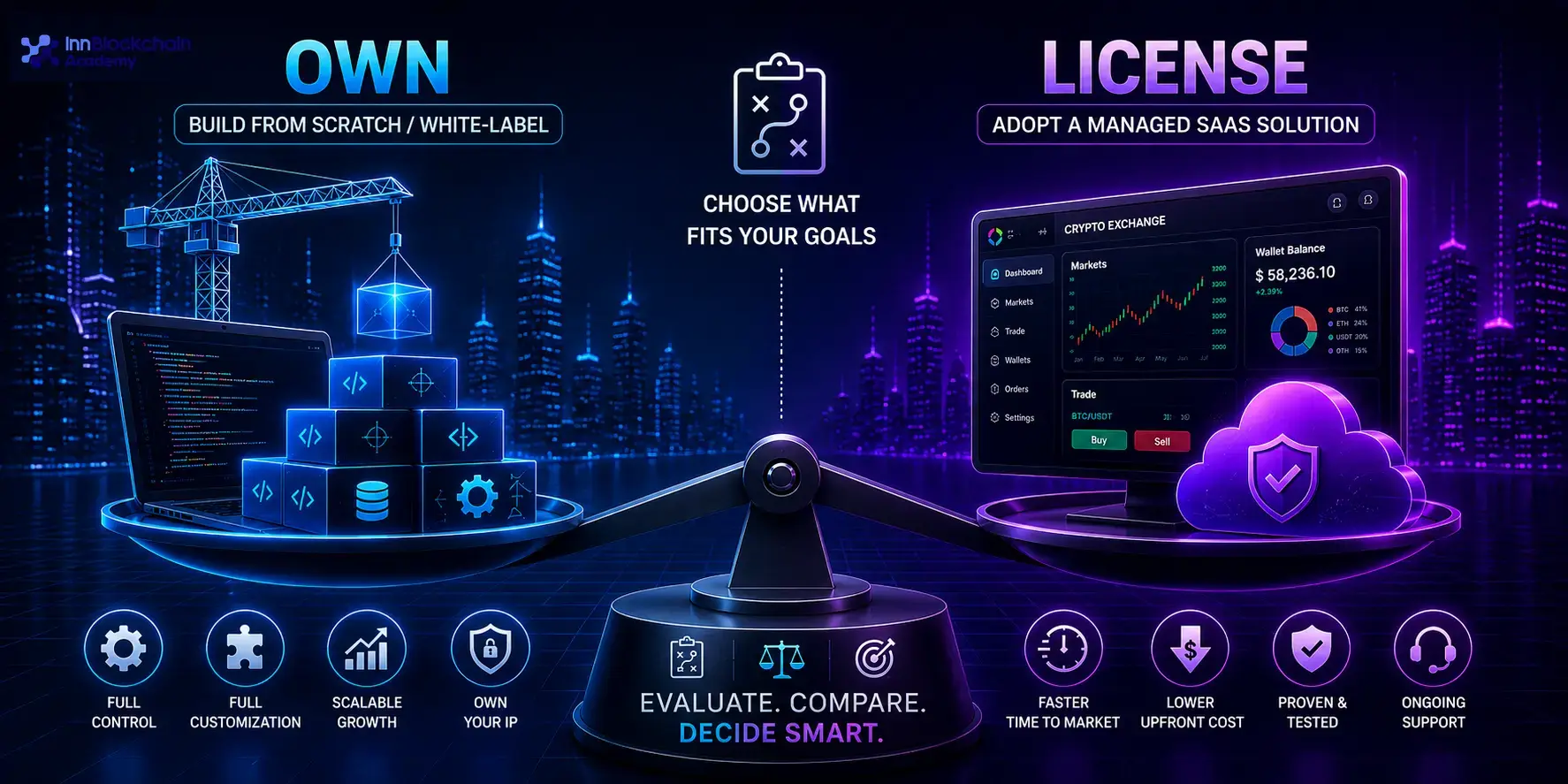
For most founders launching a crypto platform, SaaS is a common starting move. Low upfront cost, fast deployment, minimal engineering overhead. Making it a practical choice, especially in the early stages.
At low volume and early AUM, SaaS pricing works great. The monthly fee is manageable, the compliance module covers the basics, and the tradeoff feels worth it. When platforms scale or a mid-tier company opts for SaaS, the cumulative cost structure changes.
Volume-based fees, AUM percentages, per-issuance charges, and per-wallet metering each grow along with your platform.
This is one of the key dynamics in the own vs license crypto platform TCO calculation. Comparing only the upfront cost can lead founders to overlook how total expenditure evolves.
This article puts numbers to that pattern across all six crypto platform types. RWA tokenization, DEX and on-chain trading, DeFi and digital lending, MPC wallets, NFT platforms, and token launch infrastructure. Each vertical has its own SaaS cost structure, its own compounding mechanism, and its own break-even point.
First, let’s understand the fundamental differences between owned platforms and licensed services.
Understanding the difference between Owned Crypto Platforms and Licensed Solutions
Real-world Asset owners and protocol founders building a crypto platform generally face two practical scenarios.
Scenario 1
They do have a strong technical team and just need an experienced RWA tokenization platform development partner. They get their one-time paid white-label or custom-built platform from them, then operate and maintain it with their own team.
Scenario 2
They just own the asset and successfully run their business mainly offline. They don’t have an in-house team to consistently monitor and fix issues or updates. So, they go to a SaaS provider and pay the monthly/annual fee to access a managed platform.
Scenario 1 is the ownership path. A productized platform you control end-to-end 100%.
Scenario 2 is the licensed model, in which you gain access to a subscription-based service.
Here are the key differences between Owned RWA platforms and managed Platforms.
| Criteria | Productized Platform | SaaS/Licensed Platform |
| Ownership | Yes, code, contracts, and data delivered and owned outright | No, Codebase, contracts, & data stay with the vendor |
| Cost Structure | One-time Engagement (Infrastructure Costs) | Recurring monthly/annual subscription |
| Control | You control everything. Logic, UX, upgrades & compliance | Vendor controls logic, UI, upgrades & compliance roadmap |
| Resale/White-label Rights | Full Rights. Resell, white-label, or open-source freely | Not permitted. Vendor retains all the rights |
| Speed to Market | Moderate on custom-built, Fast on white-label platform(7-10 days) | Fast as it is managed and ready to deploy |
| Audit Ownership | Your deployment, your audit report, your regulator-ready record | Vendor-scoped audit, your deployment may need a separate add-on audit($15k-$40k) |
| Compliance Documentation | Deployment-specific, owned by you, directly auditable by your NCA | Generic vendor reports satisfy the vendor’s own ICT obligations. Not your deployment-specific DORA, MiFID II, MiCA(CASP) register requirements. |
| Platforms/ Providers | InnBlockchain delivers pre-audited, compliance-ready platforms with deployment-specific smart contract audits | Fireblocks, Tokeny, Securitize, Alchemy, AlphaPoint |
| Best For | Long-term ROI and full IP ownership, multi-asset/multi-deal compounding | Speed, simplicity, low upfront cost |
Not sure which model you’re evaluating?
If your platform needs custom oracle logic, asset-specific minting rules, or investor-onboarding flows that don't fit a standard template, you're likely evaluating the requirements for a custom-built RWA platform.
Well, then let’s see what your total cost is after 5 years of tokenizing your real-world assets.
Own vs License Crypto Platform TCO: The 5-Year Breakdown
When comparing costs, it is important to consider long-term expenses rather than just upfront implementation costs. Founders need to evaluate the total cost of ownership over five years.
If you have a strong technical team but need a specialist build partner, or if you have no in-house Web3 engineers at all, the platform model you choose changes the TCO fundamentally.
So, for example, I’m gonna put the collected data of your own vs license crypto platform TCO across 5 years of operation of both your own RWA tokenization platforms and SaaS providers.
The comparison drafted is for a mid-tier EU-based company. Don’t panic. These are just estimates of how much SaaS providers charge and how much a RWA tokenization development company charges.
5 Year TCO - SaaS
| Year | Subscription | AUM Fee | KYC | Issuances | Custom/Legal | Total |
| 1 | €80,000 | €4,000 | €500 | €15,000 | €50,000 | €149,500 |
| 2 | €80,000 | €10,000 | €3,000 | €15,000 | €15,000 | €123,000 |
| 3 | €90,000 | €20,000 | €6,000 | €15,000 | €20,000 | €151,000 |
| 4 | €90,000 | €30,000 | €7,000 | €10,000 | €15,000 | €152,000 |
| 5 | €100,000 | €40,000 | €8,000 | €0 | €6,000 (exit) | €208,000 |
| 5 yr | €783,500 |
5 Year TCO - White-label
| Year | Platform Delivery | Hosting | KYC | Audit | Legal | Maintenance | Total |
| 1 | €40,000 | €5,000 | €250 | €25,000 | €30,000 | €15,000 | €115,250 |
| 2 | €0 | €6,000 | €1,500 | €15,000 | €8,000 | €15,000 | €45,500 |
| 3 | €0 | €8,000 | €4,000 | €15,000 | €8,000 | €15,000 | €50,000 |
| 4 | €0 | €10,000 | €4,000 | €15,000 | €8,000 | €15,000 | €52,000 |
| 5 | €0 | €12,000 | €4,000 | €15,000 | €8,000 | €15,000 | €54,000 |
| 5 Yr | €316,750 |
Cost estimates based on published pricing tiers from Securitize, Tokeny, and Polymath as of Q1 2026, and market rate data for independent smart contract auditors. Exact costs vary by AUM, issuance complexity, and negotiated terms.
💡 White-Label Saves €466,750 over 5 years in this scenario.
The SaaS model appears cost-effective in Year 1, from a perception standpoint. But the compounding annual license fee increases total expenditure significantly over time. By Year 2, white-label ownership breaks even and stays ahead every year after.
Want the exact cost breakdown for your platform type and jurisdiction?
Book a white-label scoping call.
💡 White-label vs. custom build, two different tracks
The 5-year TCO above models the white-label path. A pre-audited, pre-built productized platform delivered in 7–10 days at €40,000–€45,000 one-time cost.
A custom-built bespoke smart contract architecture, custom oracle design, proprietary token standards, costs $75k–$250k+, depending on complexity, and ships in 3–6 months. The long-term economics are similar. One-time cost, no recurring SaaS fees, full code ownership.
If your requirements are standard for your asset class or vertical → white-label path.
If your requirements exceed the white-label scope → custom build path.
What the Own vs License Crypto Platform TCO Looks Like Per Platform Type
We can’t group the entire crypto platforms under the same category. Each is wired differently with unique specifications.
Let’s see what your total cost of ownership brings.
RWA Tokenization Platforms
RWA SaaS compounds at three levels simultaneously. AUM fees, per-issuance charges, and exit costs that grow with every investor you onboard.
- AUM fees: 0.05%–0.5% of assets under management annually. On €50M AUM: €25k–€250k/year on top of the base subscription.
- Per-issuance fees: €5,000–€25,000 per new asset tokenized. Every new deal costs money before it generates any.
- Exit costs: $30k–$80k at 1,000 investors; $200k–$600k at 2,000. The platform that grows the most pays the highest exit bill.
What productized build brings?
The ERC-3643 identity registry, investor whitelist, and transfer restriction logic are your audited contracts. AUM fees and per-issuance charges disappear. Compliance documentation is your deployment-specific record that is auditable by your NCA directly, not filtered through a vendor report.
5-year savings: €466,750 (regulated EU mid-tier operator).
Real-world proof: A UK real estate firm operating under the FCA Appointed Representative framework chose a custom-built ERC-3643 platform over a SaaS provider. Specifically because no managed platform could encode its existing compliance obligations into the token architecture.
The result: investor onboarding dropped from 10 business days to 30 minutes, with zero compliance violations across 6 months of live operation.
>> Read the full case study
DEX & On-Chain Trading Infrastructure
Volume-based fees are the primary SaaS trap for exchange operators. Your platform's success is directly taxed.
- Volume fees: 0.01%–0.05% of trading volume. At $10M monthly: $1k–$5k/month. At $100M monthly: $10k–$50k/month. At $1B monthly: up to $500k/month.
- Upgrade charges: AMM formula updates, new trading pair logic, and liquidity pool parameter changes are each a billable event on a licensed stack.
- Liquidity provider revenue sharing: Some managed DEX platforms extract a percentage of LP fee revenue on top of the subscription. Your LP returns compound against you.
What productized build brings?
Audited AMM contracts, order book logic, and Chainlink oracle integration (TWAP protection) are delivered as your code. Volume-based fees disappear. Your protocol fee structure is yours to set and keep.
5-year advantage: $120,000–$180,000 ($10M–$50M monthly volume).
DeFi & Digital Lending Protocols
TVL-based management fees mean the more liquidity your protocol attracts, the more you pay to run it.
- TVL management fees: 0.2%–0.5% of Total Value Locked annually. At $20M TVL: $40k–$100k/year before subscription.
- Liquidation engine licensing: The logic that protects your LPs from bad debt is the vendor's IP. You can't modify it, audit it independently, or take it with you.
- Protocol upgrade dependency: Collateral ratio adjustments, new asset support, or parameter changes require vendor approval. On an owned codebase, it's a governance vote.
What productized build brings?
ERC-4626 vault contracts, lending engine, and liquidation logic (health factor calculation, liquidation bonus mechanics) are delivered as audited Solidity code you own. All yield flows to your LPs and protocol treasury, none to the platform.
5-year advantage: $100,000–$160,000 ($15M–$30M TVL).
MPC Wallets & Crypto Custody Infrastructure
Per-wallet billing turns every user you acquire into a recurring cost event. Growth compounds against your unit economics.
- Per-wallet monthly fees: $0.50–$5.00 per wallet/month. At 50,000 wallets: $25k–$250k/month. At 200,000 wallets: $100k–$1M/month.
- Key management dependency: Your users' signing keys sit in the vendor's MPC cluster. A pricing change, API restriction, or breach is the vendor's decision and your users' problem.
- eIDAS 2.0 roadmap lock-in: EU-regulated wallets must accept the EUDI Wallet as a relying party by 31 December 2026. On SaaS, that integration ships on the vendor's schedule.
What productized build brings?
MPC key management architecture (threshold signatures, distributed key generation), multi-chain integration, and stablecoin settlement contracts are delivered as your code. Per-wallet billing is eliminated — cost base is fixed infrastructure. EUDI Wallet integration is your engineering sprint, on your timeline.
5-year advantage: $80,000–$140,000 (50,000–100,000 active wallets).
NFT Platforms & Marketplaces
Marketplace revenue sharing permanently extracts a percentage of every secondary sale. Volume that should stay with the platform operator and creators.
- Revenue sharing: 2%–5% of secondary sale volume. At $500k monthly secondary sales: $10k–$25k/month extracted indefinitely.
- Per-mint fees: $0.10–$2.00 per token or 1%–3% of mint revenue. On a 10,000-token collection at 0.05 ETH floor: $500–$3,000+ per drop.
- Creator relationship lock-in: Royalty configurations, account data, and sales history live in the vendor's system. Migrating a creator base means rebuilding every relationship from scratch.
What productized build brings?
ERC-721/ERC-1155 contracts, sale logic (fixed price, Dutch auction, whitelist), and ERC-2981 royalty enforcement are delivered as your code. Revenue sharing disappears. Creator relationships and royalty records are in your infrastructure.
5-year advantage: $70,000–$130,000 ($200k–$500k monthly secondary volume).
Token Launch & IDO Launchpad Infrastructure
Per-launch fees and token allocation charges reduce the effective capital raised on every TGE your platform runs.
- Per-launch fees: $5,000–$25,000 per IDO/TGE. At three launches per quarter: $60k–$300k/year before any subscription cost.
- Token allocation charges: 2%–5% of tokens raised. At a $2M TGE at 3%: $60,000 per launch extracted in tokens — permanently diluting your raise.
- Vesting and whitelist dependency: Cliff, linear, and graded vesting contracts are the vendor's code. Participant KYC and whitelist data live in their system, not yours.
What productized build brings?
Vesting contracts (cliff/linear/graded), FCFS/auction/whitelist sale contracts, and Merkle-tree airdrop contracts are delivered as your code. Per-launch fees and token allocation charges disappear. Participant KYC records and whitelist data stay in your infrastructure.
5-year advantage: $60,000–$100,000 (3–6 IDOs/year).
Who owns the audit, and who owns the risk?
On a managed SaaS platform, the smart contracts were audited by the vendor's chosen auditor, scoped for the platform, not for your deployment, your asset class, or your jurisdiction. That distinction matters more than most buyers realise until it's too late.
⚠️ Point to note: "The platform was audited" and "your deployment was audited" are not the same statement. Regulators treat them as different documents.
| SaaS Platform | Productized Build | |
| Platform Audit | Vendor-owned, Vendor-scoped | N/A |
| Your Deployment Audit | Add-on $15-$40k extra | Bundled in delivery |
| Regulator-ready Report | Partial at best | Complete, deployment-specific |
| Audit-Ownership | Vendor | You |
When regulators review any crypto platform operating under an EU framework, they may ask for proof that the smart contracts powering your specific deployment have been independently audited. A generic audit report provided by a platform vendor is usually not enough.
Regulators expect an audit that specifically covers
- Your smart contracts
- Your configuration settings, &
- Your issuance structure
The challenge becomes greater when any customization is introduced. Features such as KYC whitelisting, custom liquidation logic, royalty enforcement rules, vesting schedules or AMM parameter changes distribution rules may not be included in the platform's original audit scope. As a result, you will often need a separate audit for your deployment, even if the changes seem minor.
Depending on the complexity of the contracts and the reputation of the auditing firm, these project-specific audits can typically cost between $15,000 and $40,000.
💡 Highlight: On a productized owned build, the audit is scoped for the delivered contracts, which are your contracts. The report is yours. The findings are yours. The remediation trail is yours. When a regulator asks, you hand over a single document that answers the question completely.
For a non-technical founder building a crypto platform, the platform decision is secondary to a more fundamental question: Does the smart contract actually reflect the intended business and legal logic? A contract bug doesn't just cause financial loss. It can misroute funds, duplicate rights, or break compliance rules in ways that may be impossible to unwind. This is why deployment-specific audits are non-negotiable across all verticals, regardless of the protocol you run. The business logic being put on-chain is real, and the legal and financial consequences of a contract error are real.
Want to understand which model fits your situation? Book a white-label scoping call.
Beyond the cost comparison, there are structural and operational differences between the two models that are worth examining before making a platform decision.
Beyond Costs: The Ownership Vs Access. What each model offers
🔒 Stack Ownership
On a productized build, the smart contracts, the compliance logic, the oracle integrations, and the UI layer are delivered to you as code you own outright. Your platform’s operational continuity is independent of any vendor relationship. On a SaaS model, operational continuity depends on the vendor’s pricing decisions and roadmap. A trade-off that is acceptable for many operators but worth understanding explicitly.
⚡ Multi-Platform Speed
The first build is always the hardest. On an owned crypto platform
- Platform-specific logic is configurable, not re-coded for each new product
- Compliance modules are reusable across deployments
- New features and verticals go live faster once the core infrastructure is in place
On a SaaS platform, the managed environment means less upfront configuration, which benefits operators launching a single or limited product line.
🔧 Handling Complex Use Classes
SaaS platforms are generally optimized for common, standardized use cases and work well for operators fitting that profile.
A productized build may be suitable for
- Multi-vertical platforms(like running DEX, lending, and wallet under one stack)
- Custom protocol logic(AMM formulas, liquidation engines, vesting structures)
- Multi-jurisdiction compliance stacks within a single deployment
🏆 Platform Vs Service Model
For operators whose business model involves powering other clients on top of their infrastructure, an owned platform enables that
- Clients bring you their use case and you configure, not rebuild
- Each deployment strengthens the platform's shared logic library
- Audit history compounds across products
- You price and position as a platform provider, not a service engagement
IP Ownership: Resale, White-Label, and Open-Source Rights
A SaaS licence grants access to the platform. Intellectual property remains with the vendor.
On a productized build, you receive the complete source code of smart contracts, frontend, backend, and all integration layers with full intellectual property ownership.
That means
- You can resell your platform to other operators or clients without licensing restrictions.
- You can white-label your platform under your own brand and offer it to your customers as a product.
- You can open-source your contracts for community trust-building and audit transparency.
- You can fork, modify, and extend any component without permission, approval, or change-order fees.
For operators whose business model does not involve sub-licensing or resale, the SaaS model may still be a workable fit. The IP restriction becomes a limiting factor primarily when platform resale or white-labeling is part of the business model.
Platform Scalability
For regulated FinTech leaders, the launch cost is only part of the calculation. Years 2 and 3 introduce questions around market expansion, new verticals, and regulatory documentation.
On a productized build
- Expanding to a second EU jurisdiction means updating the compliance module, not renegotiating with a vendor
- Adding a new vertical or product uses the existing contract architecture
- Regulatory audits work from your deployment-specific documentation
On a SaaS platform
- Expansion may be faster due to the vendor’s managed environment and existing multi-jurisdiction support
- New vertical or product support depends on the vendor’s roadmap
- Regulatory documentation is partially vendor-scoped, which may or may not satisfy your NCA’s requirements
For firms targeting institutional investors or cross-border capital, understanding which of these trade-offs applies to your jurisdiction and regulatory context is critical before committing to either model.
Which EU Framework Applies to Your Platform and Why Ownership Changes the Risk
EU enforcement is not theoretical. H1 2025 financial institution fines reached $1.23 billion (+417% vs H1 2024). MiCA enforcement since Dec 2024, €540M+ in fines. When your compliance documentation routes through a vendor, the exposure is yours.
| Vertical | Primary EU Framework | Key Deadline | SaaS Compliance Risk | Ownership Advantage |
| RWA Tokenization | MiFID II+Prospectus Regulation+DLT Pilot Regime | Listing Act Amendments: Mar 2026/Jun 2026 | Vendor audit report ≠ NCA deployment-specific audit | Your contract address, Oracle sources, and investor flows are yours. Directly audited by BaFin/AMF/AFM |
| DEX/Exchange | MiCA Title V CASP | Transition deadline: 1 Jul 2026 | CASP white paper covers vendor stack, not your deployment | Your CASP filing documents your own deployment. No vendor intermediary in the regulatory record. |
| DeFi/Lending | MiCA Title V+ DORA | MiCA: 1 Jul 2026/DORA: in force Jan 2025 | DORA ICT register lists a vendor, their uptime, incidents, and sub-processors are your exposure | Your ICT register = your own RPC endpoints, cloud stack, and key management. 2% of annual turnover penalty for gaps |
| MPC Wallet | eIDAS 2.0+PSD3+DORA | eIDAS 2.0: 31 Dec 2026/PSD3: late2027 | EUDI wallet integration depends on vendor roadmap; PSD3 strong auth requirements on vendor’s API | EUDI wallet integration is an engineering sprint on your infrastructure, controlled by you |
| NFT Platform | DORA(if licensed)+EU AMLR | DORA: Jan 2025/AMLR: Jul 2027 | Compliance documentation for any regulatory inquiry routes through the vendor | Creator KYC data, royalty records, and transition logs are in your own infrastructure |
| IDO Launchpad | MiCA Title V(if CASP scope)+EU AMLR | MiCA: 1 Jul 2026/AMLR: Jul 2027 | Participant KYC and whitelist data in the vendor system, NCA access routes through the vendor | Participant eligibility, KYC records, and token distribution logic are your deployment, your documentation. |
Compliance framework source: The audit table above is the vendor risk document your NCA expects. All EU Compliance deadline dates are per the official EU legislative record.
The own vs license crypto platform TCO calculation doesn't end at the subscription line. Every EU compliance deadline above adds cost to the SaaS side and zero to the owned side because the integration is your engineering sprint, not the vendor's roadmap.
Own or License: The Decision Tree
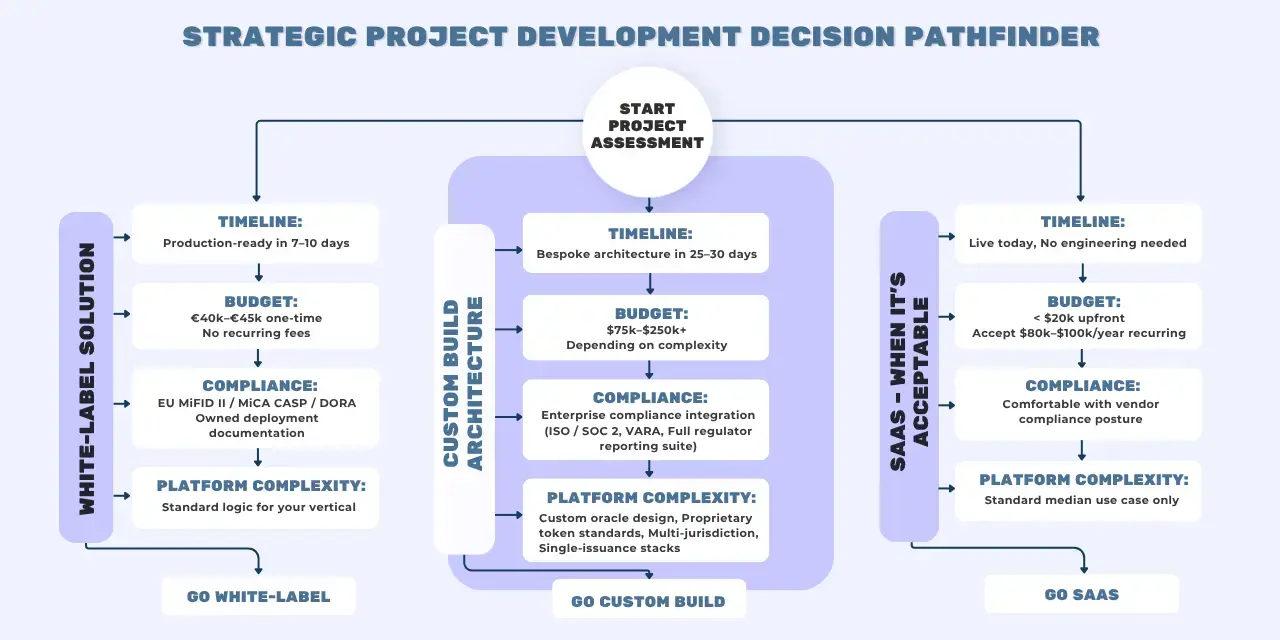
The right answer depends on four variables. The timeline, budget, compliance requirements, and platform complexity. Use this matrix to self-qualify before booking a scoping call.
| Decision | White-label | Custom Build | SaaS - When it’s acceptable |
| Timeline | Production-ready in 7-10 days | Bespoke architecture in 25-30 days | Live today, no engineering needed |
| Budget | €40k–€45k once, no recurring fees | $75k–$250k+ depending on complexity | <$20k upfront; accept $80k–$100k/year recurring |
| Compliance | EU MiFID II / MiCA CASP / DORA, owned deployment documentation | Enterprise compliance integration (ISO/SOC 2, VARA, full regulator reporting suite) | Comfortable with vendor compliance posture |
| Platform Complexity | Standard logic for your vertical | Custom Oracle design, proprietary token standards, multi-jurisdiction, single-issuance stacks | Standard median use case only |
Own vs. License: The Summary
Both models come with a distinct cost and control profile that compounds over time.
SaaS typically involves lower upfront investment and faster time to market, but carries recurring fees that scale with your platform's growth:
- Volume fees tied to trading activity
- AUM fees tied to assets under management
- Per-wallet fees for each user added
- Per-issuance and per-launch fees for each new asset or fundraise
For operators at early stages or with moderate growth expectations, these costs may be well within an acceptable range.
Productized (white-label or custom) builds require a higher upfront investment, but eliminate recurring platform fees and deliver full IP and code ownership. This model is better suited for operators planning multi-asset, multi-jurisdiction, or multi-client operations at scale.
The right choice depends on your timeline, budget, technical resources, regulatory requirements, and the business model you are building toward. Neither model is universally superior — the TCO and operational trade-offs differ by context.
If you are evaluating which model fits your situation, InnBlockchain offers pre-audited white-label crypto platforms as well as custom builds. And can provide a scoping assessment to help you compare options for your specific use case.
Code owned outright. No annual licence fees, vendor lock-in, exit cost. Every contract is written with an audit in mind. Compliance logic, access control, and upgrade architecture are design inputs, not afterthoughts.
You've spent years building something worth protecting. Don't hand its future to a vendor who won't be accountable when it matters. Let's build it right, once, and make it yours.
Ready to Build Your Platform?
Talk to InnBlockchain → Start Here
FAQs
A white-label build starts at $20,000–$45,000 as a one-time delivery cost. Annual running costs after that are $8,000–$15,000, no AUM fees, no volume charges, no lock-in.
It depends on your scale and use case. SaaS platforms compound fees (subscription + AUM + issuance + volume) to $150,000–$780,000+ over 5 years. A productized build costs $64,000–$316,750 for the same period, breaking even by Year 2.
Beyond the headline subscription, per-investor KYC fees, AUM/TVL percentages, per-transaction fees, per-issuance or per-drop charges, smart contract upgrade fees, and exit/migration costs of $30,000–$600,000.
Vendor lock-in means your platform's uptime, upgrades, and compliance depend entirely on a third party's roadmap and pricing. On SaaS, you don't own the contracts or data; the vendor does.
Verticals where AUM, TVL, or transaction volume grows significantly over time, such as RWA tokenization, DEX, DeFi lending, and IDO launchpads, are most exposed to compounding SaaS fees. Verticals with lower or more stable volumes may see less impact.
SaaS suits early-stage MVPs, quick launches without in-house engineering, or platforms where volume stays modest. It works well when a fully managed infrastructure and vendor-handled compliance updates are the priority. When scale grows or IP ownership matters, a productized build becomes worth the comparison.