
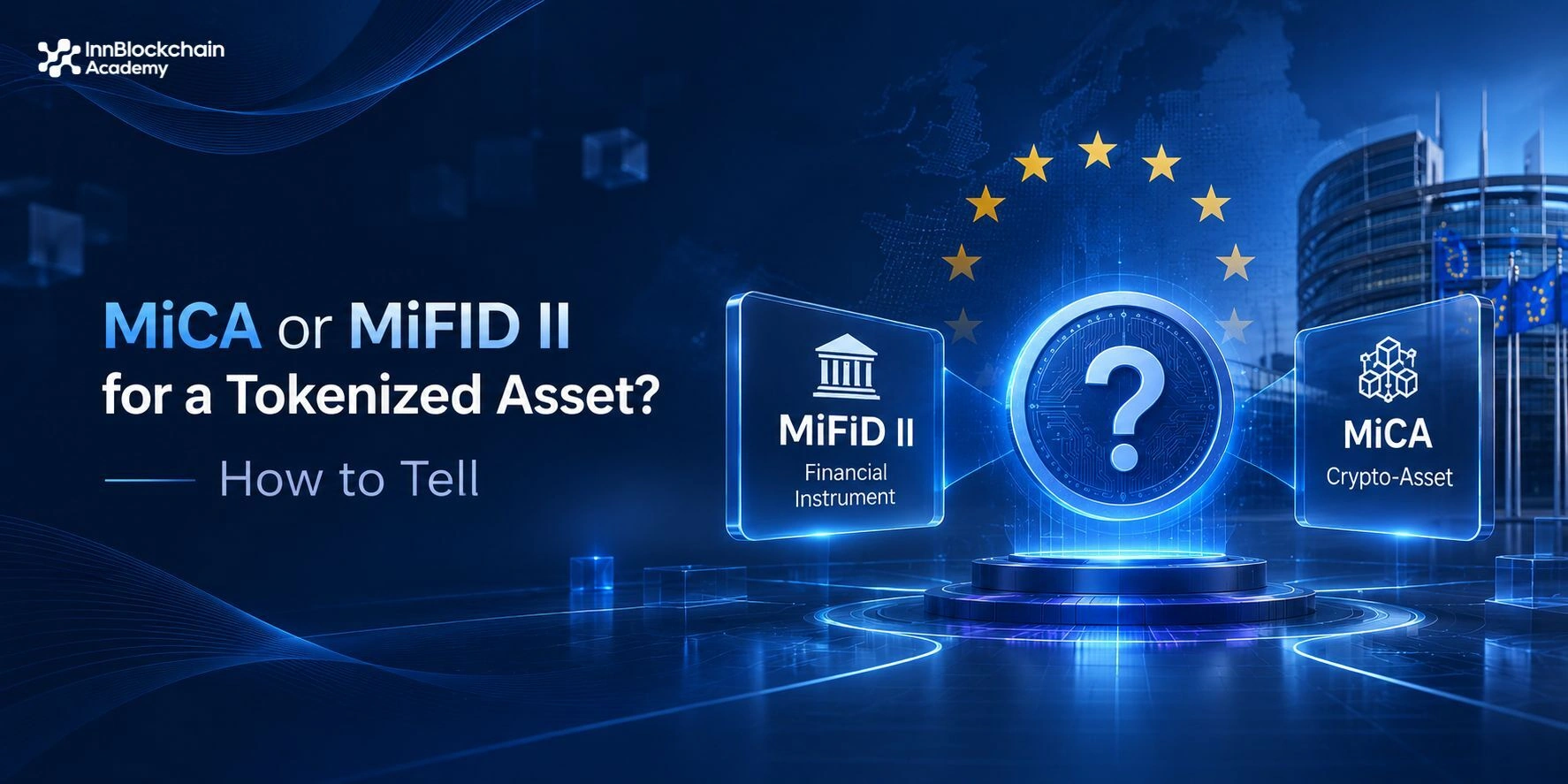
The question in the title has a stricter answer than most people expect. A token cannot sit under both regimes. A token is either a crypto-asset under MiCA or a financial instrument, but never both. So what is the deciding factor? It's simple. What the token gives the holder. Its label, its blockchain and the issuer's preferred paperwork don't change the answer.
The harder part is that no one gives you the answer. Supervisors and ESMA publish guidance, but the decision is yours as the issuer. You make it with your lawyers and put it in writing. Everything else depends on that decision: the offering document, which authorizations the firms around you need, the venue that can admit the token, and the market-abuse rules that apply. If the decision is wrong, all of these are wrong too.
Who this is for. This guide is for two kinds of readers who share the same question.
- Asset owners: owners of real estate, private credit, equipment or other assets who plan to sell tokens to investors in the EU.
- Licensed firms: asset managers and securities firms putting a fund unit or security they already manage on a blockchain.
It covers EU rules only.
This guide is the initial step on deciding what your token is. If you already know your token is a financial instrument, skip ahead to which EU rules apply to a tokenized security.
You don't need to read every section. Each one starts by saying who it applies to.
Short on time? Here's the gist
- MiCA does not apply to a crypto-asset that qualifies as a financial instrument (MiCA Art 2(4)(a)). So the MiFID II test runs first.
- MiFID II's definition of a financial instrument expressly includes instruments issued on a distributed ledger (Art 4(1)(15)).
- Ownership of a company or SPV, a debt claim, or a unit in a pooled fund points to MiFID II. A token that only references a value, with no claim behind it, points to MiCA.
- Most tokenized real-world assets land on the MiFID II side. A share in the company that owns the asset, a note paid from its income or a fund unit are all financial instruments.
- If yours lands on the MiCA side, it is a different regime with its own authorizations. This guide names it and stops there.
Why can a token not be both?
Applies to any token offered to investors in the EU.
MiCA lists what it doesn't cover in Article 2(4). The first item on that list, Article 2(4)(a), is crypto-assets that count as financial instruments. The list also excludes deposits, insurance and pension products, securitization positions and a few others.
MiFID II closes the loop from its side. Since the DLT Pilot Regime amended it, Art 4(1)(15) defines a financial instrument as "those instruments specified in Section C of Annex I, including such instruments issued by means of distributed ledger technology". A share is a share whether it sits in a paper register, a central securities depository or a smart contract.
So the order of the test is fixed, and it starts on the MiFID II side.
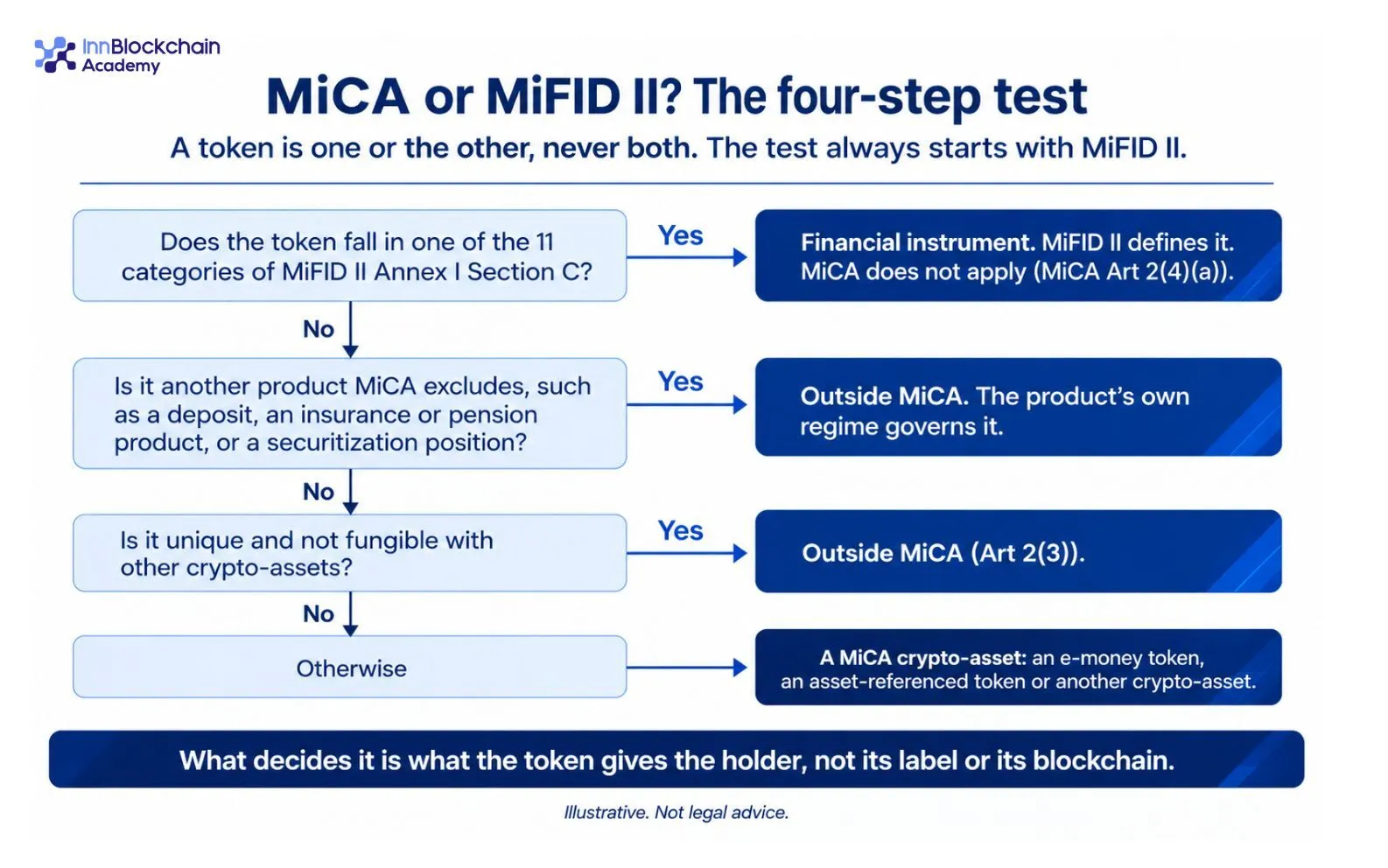
Most of the work is in step 1. That is where most tokenized assets land, whether it is a share or note backed by a building or loan book, or a fund unit a licensed firm already manages.
What makes a token a financial instrument?
Applies if the token gives the holder a right against an issuer, a vehicle or an asset.
Annex I Section C of MiFID II lists 11 categories. Three are the ones tokenized assets meet in practice.
- Transferable securities (C(1)),
- Money-market instruments (C(2)) and
- Units in collective investment undertakings (C(3)). The rest are derivatives and emission allowances.
Most asset tokens fall into the first category: transferable securities. MiFID II defines these in Art 4(1)(44). In plain terms, they are securities that can be traded on capital markets, not payment instruments like cheques.
The definition gives three main examples:
- Shares in companies and equivalent securities in partnerships or other entities (Art 4(1)(44)(a)). A token that is a share in the SPV owning a building sits here.
- Bonds and other forms of securitized debt (Art 4(1)(44)(b)). A token that is a note paid from rent, lease income or loan repayments sits here.
- Any other security giving a right to acquire or sell those securities, or a cash settlement determined by reference to securities, currencies, rates, commodities or indices (Art 4(1)(44)(c)).
Three parts of this definition matter most when you tokenize an asset.
It is about classes, not individual pieces. A security comes in a class of units with the same terms. Fractions of one asset, issued on identical terms to many investors, are a class by construction.
It does not wait for a listing. Art 4(1)(44)(a)'s own examples are shares in companies, partnerships and other entities. Nothing says they must be listed or traded anywhere. A share in a private SPV is in the list, and recording it as a token does not take it out.
It is about rights, not about payouts. If a token gives ownership, it is an ownership instrument even if it never pays anything. The reverse also applies. A token that pays a return without giving ownership can still be a transferable security, if it gives the holder a legal claim they can enforce against the issuer. These middle cases are decided one by one, which is where a written legal opinion is worth paying for.
The Prospectus Regulation uses this same definition. Under Article 2(a), "securities" means MiFID II transferable securities. The only exception is money-market instruments that mature in less than 12 months. So, if your token is a transferable security, the prospectus rules may apply. If it isn't, they don't.
What MiFID II does not do to an issuer. Your asset being classified under MiFID II doesn't require the issuer to hold a MiFID II authorization. Authorization attaches to the firms that place, trade, advise on or safekeep the instrument for others. Your duties as the issuer then come mainly from two rules. The Prospectus Regulation applies first. The Market Abuse Regulation applies once the token is admitted to trading on a venue, or admission is requested. Both are covered in which EU rules apply to a tokenized security.
When is the token a fund unit rather than a share or a note?
Applies if investors' money is pooled and someone else decides how it is invested.
Units in collective investment undertakings are their own category, C(3). For classification, that means one thing: a tokenized fund unit is a financial instrument, and MiCA does not apply to it. Whether the fund is a UCITS or an alternative investment fund (AIF), and whether its token is open- or closed-ended, does not move it across the MiCA line.
Whether a vehicle is a collective investment undertaking is decided under the fund rules, not under MiFID II. For an AIF, AIFMD Art 4(1)(a) looks for these three things,
- Capital is raised from a number of investors
- It is invested under a defined investment policy for the benefit of those investors
- The vehicle is not a UCITS (the regulated retail-fund type)
Two practical consequences for an asset owner
- A single asset does not keep you out. Pooling several investors' money into one building, managed for them, can still be a fund. Fractionalizing adds investors; it neither creates nor avoids a fund.
- The SPV is a wrapper, not an answer. Putting the asset in an SPV changes who holds legal title. It does not change whether the arrangement is a fund.
Being a fund unit (C(3)) doesn't change the MiCA answer. It changes which rules apply next. Units of open-ended funds are outside the Prospectus Regulation entirely, while closed-ended units are inside it (Prospectus Regulation Art 1(2)(a)), and the manager carries its own fund-rule duties. Those consequences belong to the next step, after classification.
Where does MiCA begin?
Applies only if the token is not a financial instrument and no other exclusion fits.
MiCA defines a crypto-asset broadly: a digital representation of a value or a right that can be transferred and stored electronically using distributed ledger technology or similar technology (MiCA Art 3(1)(5)). Anything that clears the steps above and fits that definition is in scope, in one of three categories.
| MiCA category | What defines it | What the issuer faces before an offer to the public |
|---|---|---|
| E-money token (Art 3(1)(7)) | Aims to keep a stable value by referencing one official currency | The issuer must be authorized as a credit institution or an electronic money institution, and must notify and publish a white paper (Art 48(1)) |
| Asset-referenced token (Art 3(1)(6)) | Aims to keep a stable value by referencing another value or right, or a combination, and is not an e-money token | The issuer must be authorized under Art 21 or be a credit institution (Art 16(1)), with exemptions in Art 16(2) for small issuances and for offers only to qualified investors |
| Other crypto-assets (Title II), including utility tokens (Art 3(1)(9)) | Everything else: access, governance, platform tokens | The offeror must be a legal person and draw up, notify and publish a crypto-asset white paper (Art 4(1)) |
If your token lands in this table, MiCA governs it, and this guide stops here. A MiCA issuance needs a different disclosure document, different authorizations and advice built for that regime. Beyond classification, this guide covers tokens that are financial instruments. On the MiCA side, InnBlockchain builds platforms for firms seeking authorization as crypto-asset service providers, such as exchanges and custody services.
One place an asset owner does meet MiCA without becoming a MiCA issuer is the settlement asset. If investors pay for a tokenized security in an e-money token, the security stays under MiFID II and the payment leg is a MiCA crypto-asset. Paying in an e-money token brings consequences of its own. For example, it adds anti-money-laundering checks, which we explain in the transfer gate for EU tokenized securities. Make this choice on purpose, not by default.
Which side do common tokenized assets land on?
Applies if you are mapping your own structure. The right-hand column gives the direction the criteria point, not a conclusion about your token. Your documents decide that.
| The token gives the holder… | Points toward | Why |
|---|---|---|
| A share in the SPV or company that owns a building, fleet or loan book | MiFID II, C(1), point (a) | An ownership instrument in an entity, issued in a class |
| A note or bond repaid from rent, lease income or loan repayments | MiFID II, C(1), point (b) | Securitized debt |
| A unit in a vehicle that pools investors' money under a manager's investment policy | MiFID II, C(3) | A unit in a collective investment undertaking |
| A unit in a money-market or treasury fund | MiFID II, C(3) | Tokenizing a treasury bill usually means tokenizing a fund that holds it |
| A share of the revenue of a project, with an enforceable claim on the issuer | Probably MiFID II. Check | Revenue rights that amount to a claim on the issuer can be a transferable security |
| A price exposure to gold or a commodity basket, with no ownership and no claim on an issuer or vehicle | MiCA, asset-referenced token | Value-referencing without ownership |
| Access to a platform or service, and nothing else | MiCA, other crypto-asset or utility token | Only intended to give access to the issuer's goods or services |
| A single token for one unique artwork, sold whole | Outside MiCA (Art 2(3)), but check the sale | Unique and not fungible |
| Fractions of one artwork, sold to investors on identical terms | Not unique. Run step 1 | The fractions are fungible with each other, so the uniqueness exclusion does not fit them. What they confer decides the rest |
Two rows need a closer look.
- Revenue-share tokens. This is where most tokens get the wrong label. A token sold as "utility" that also pays out is doing more than giving access. MiCA defines a utility token narrowly, as one only meant to give access to the issuer's goods or services. Once a token pays a return, it no longer fits that definition.
- Commodity tokens. The answer depends on what the holder can claim. If the token gives ownership of the gold, or a claim on the company holding it, it is an ownership instrument. If it only tracks the gold price, it isn't.
Where do classifications most often go wrong?
Applies to anyone who has been told their token is "probably MiCA" or "probably not a security".
These are common mistakes, each checked against the legal text.
| What people say | What's actually true |
|---|---|
| "It's a real-world asset, so MiCA covers it." | MiCA has no real-world-asset category. "Real-world asset" describes where the value comes from, not what the token is. A token that gives ownership of an asset-holding company is a financial instrument, so MiCA doesn't apply. Some RWA tokens do fall under MiCA, such as a token that only tracks the gold price, but because of what they give the holder, not because they're RWAs. |
| "Fund units are excluded from MiCA because they're funds." | The answer is right, but the reason is wrong. MiCA's "funds" exclusion (Art 2(4)(c)) means money under the Payment Services Directive, not investment funds. A fund unit is outside MiCA because it's a financial instrument (C(3)), under Art 2(4)(a). |
| "It runs on a public blockchain, so it's a crypto-asset." | MiFID II Art 4(1)(15) covers financial instruments "issued by means of distributed ledger technology". Issuing on a blockchain doesn't change what the token is. |
| "It doesn't pay a yield, so it's not a security." | Ownership counts with or without payouts. A share that has never paid a dividend is still a share. |
| "We'll call it a utility token." | The name doesn't decide anything. What the holder can claim does. |
| "The trading venue decides it." | A DLT venue trades and settles financial instruments. It doesn't change what a token is. Classification comes first, and the venue's rules follow. |
Who makes the call, and what should the record of it contain?
Applies to every issuer, on either side of the line.
The issuer makes it, documents it with counsel, and carries the consequences if a supervisor later reads the token differently.
Three external sources feed the decision, and none of them replaces the issuer's own analysis:
- ESMA guidelines. MiCA Art 2(5) required ESMA to issue guidelines on the conditions and criteria for qualifying crypto-assets as financial instruments by 30 December 2024. Check the version in force on the day you decide, and record which one you used.
- National guidance. Several national supervisors publish their own notes on token classification. Where you offer into a Member State, its supervisor's view is the one you will meet.
- National civil law. Each EU country decides whether a blockchain record can be the security itself, or only serve as proof of one recorded somewhere else. EU rules don't answer this. It won't change whether your token falls under MiCA or MiFID II, but it does change how the token is built.
What we ask to see before scoping a build. Not a legal requirement, but the record we work from, because every contract decision downstream reads one of its lines:
| Line in the classification record | What it decides in the build |
|---|---|
| The rights the token gives, listed one by one | Which rights the contract enforces, and which stay in the legal documents |
| Who issues it, and whether a company (SPV) sits between investor and asset | Who controls the token: who can freeze, recover, pay out and update it |
| Whether investors' money is pooled and managed by someone else | Whether fund controls are needed at all, such as subscription windows, redemptions and valuation dates |
| The Annex I Section C category (or the MiCA category) | Which offering document is linked to the token on-chain, and which rules the transfer gate must check |
| The settlement asset and how it is classified | Whether paying in that asset brings extra rules of its own |
| The guidance versions and national guidance used, with dates | When the record needs to be checked again |
| Who signed off on the classification, and when | Who the build team checks with if the token's terms change |
A classification that changes after launch is among the most expensive changes a project can face, because it changes the document, the gate and the people around you at once. That's why classification comes first above all.
Two things classification does not decide. It does not pick your token standard, since neither MiCA nor MiFID II requires one. It also does not make the token liquid: a financial instrument can move between eligible holders, but whether anyone buys it is a separate question.
Your next step, based on your answer
Keep a written record of your classification. Investors, partners and regulators will ask for it. It should state what rights the token gives, whether investors' money is pooled and managed, and which MiFID II category that places it in.
If it's a financial instrument, more EU rules apply. Our EU tokenization regime guide explains what they mean for your platform.
- Licensed firms: see our tokenization development for authorized firms, or book an architecture review.
If it's a MiCA crypto-asset, this guide stops here. On the MiCA side, we build platforms for firms seeking authorization as crypto-asset service providers, such as exchanges.
Read next: Which EU rules apply to a tokenized security. If you're new to tokenization, start with what asset tokenization is.
This is engineering commentary on regulatory requirements, not legal advice. How a particular token is classified depends on its documents and needs sign-off from counsel.
Frequently asked questions
Can a token be regulated under both MiCA and MiFID II?
No. MiCA Art 2(4)(a) excludes crypto-assets that qualify as financial instruments, and MiFID II's definition of a financial instrument expressly includes instruments issued on a distributed ledger (Art 4(1)(15)). A token is one or the other, so the MiFID II test runs first.
Is a tokenized real estate share a MiCA crypto-asset?
Generally not. A token that is a share in the company or SPV owning the property is a transferable security under MiFID II Art 4(1)(44), so MiCA does not apply to it. Whether your particular token is a share depends on what your documents give the holder.
Are tokenized fund units covered by MiCA?
No. Units in collective investment undertakings are financial instruments under MiFID II Annex I Section C(3), so MiCA's Art 2(4)(a) carve-out applies. The "funds" exclusion in Art 2(4)(c) is about money as defined in payment law, not investment funds.
Does a token have to pay a yield to be a security?
No. A token that confers ownership of an entity is an ownership instrument whether or not it ever pays a distribution. A token that pays a return without ownership can also be a security if it gives an enforceable claim on the issuer. That middle ground is case-by-case.
Is a gold-backed token MiCA or MiFID II?
It depends on what the holder owns. A token that gives ownership of, or a claim on, a vehicle holding the gold points to MiFID II. A token that only references the gold's value, with no ownership claim, points to MiCA's asset-referenced token category.
Who decides how my token is classified?
The issuer, with counsel. ESMA's guidelines under MiCA Art 2(5) and national supervisors' guidance inform the decision, but the call and its consequences sit with the issuer. Record which guidance versions you relied on and when.