
| Firm | DIVACS, Inc., USA (real estate) |
| Regulations | Regulation D (Rule 506(b)), Regulation S, Rule 144 |
| Blockchain | Ethereum mainnet |
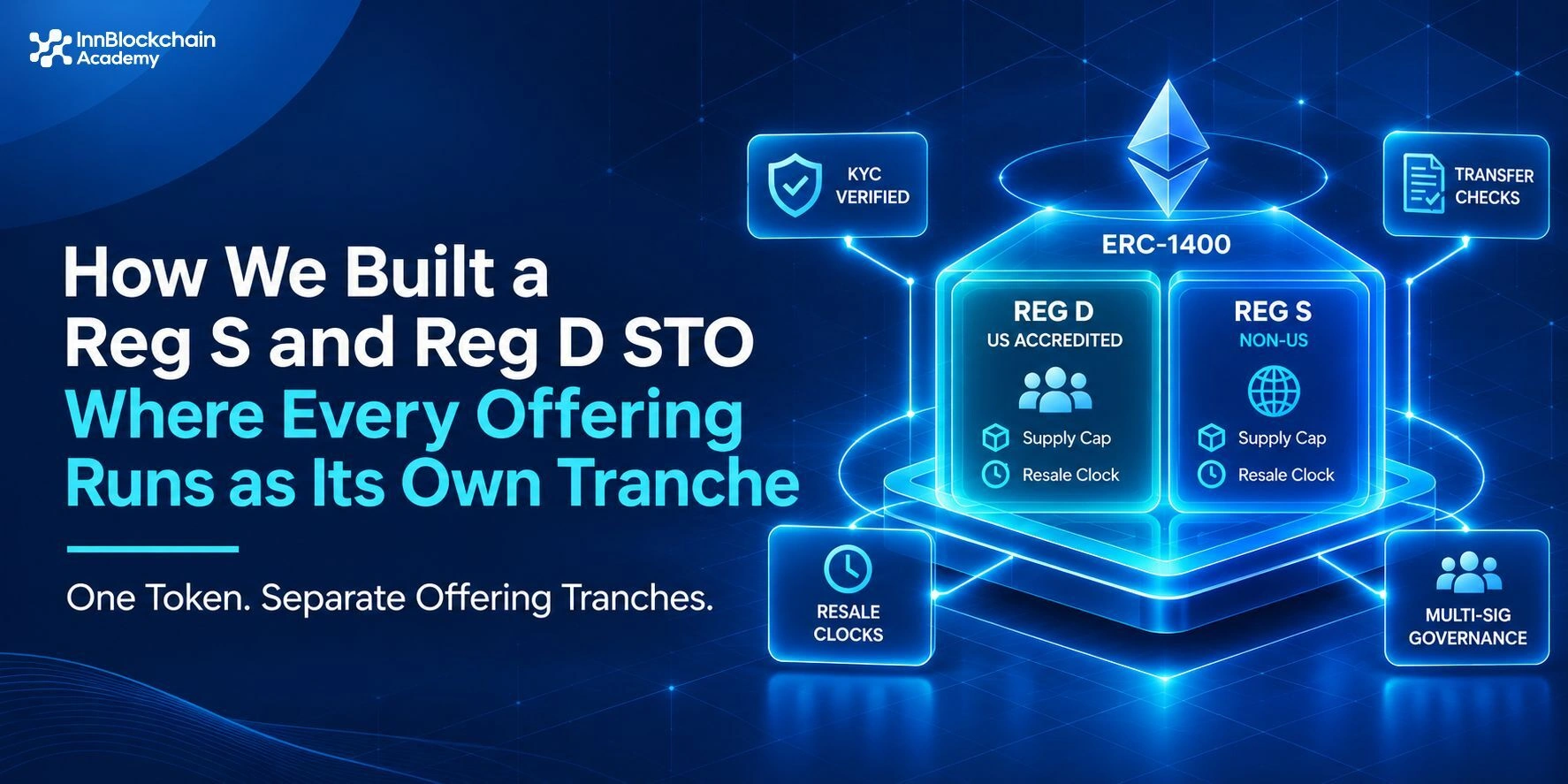
| Token Standard | ERC-1400 (ERC-1410 partitions, ERC-1643 documents, ERC-1644 controller operations) with transfer pre-checks |
| Investor Eligibility | Reg D tranche: verified accredited US investors. Reg S tranche: non-US investors |
| Challenge | Keeping each offering's supply and resale restrictions separate on one token, and keeping US and non-US investors in the right tranche |
| Solution | A tranche-per-offering security token with an on-chain identity registry, an on-chain document registry, multi-signature governance and an admin panel |
The Situation
DIVACS, Inc. is a US real estate company that raises capital privately from US investors under Regulation D and from non-US investors under Regulation S.
A company that raises more than once needs each round kept apart, with its own supply and its own resale timing. Once a company has a second round and both US and non-US investors, three questions get harder to answer. Who holds what, under which round, and when are they allowed to sell?
DIVACS needed a Reg S and Reg D STO where the register itself keeps the rounds apart and enforces each round's resale timing.
The Task
The requirement was not just to record investors. It was to build a setup that enforces the securities-law transfer rules in the token itself, not by manual review.
Each offering had to run as its own tranche, either Reg D for US accredited investors or Reg S for non-US investors, with its own supply cap, issuance switch and resale clock. A transfer that a tranche's restrictions don't allow had to be refused by the system, not caught later in a review.
Regulatory Framework: Regulation D, Rule 506(b)
Rule 506(b) has no dollar limit. These are the conditions the issuer must meet:
- No general solicitation: The offering can't be publicly advertised. Issuers typically rely on investors they already have a relationship with.
- Purchasers: Any number of accredited investors, plus at most 35 non-accredited purchasers who must be financially sophisticated and receive prescribed disclosure. DIVACS' offering admits accredited investors only.
- Restricted securities: Securities sold under Reg D can't be resold freely. For a non-reporting issuer, Rule 144 sets a one-year holding period from full payment before resale.
- Form D: A notice is filed with the SEC within 15 days of the first sale, with state notice filings where investors live.
The issuer and its counsel own these conditions: who is approached, how investors qualify, and the filings. The technology's job is to keep the record and stop transfers the rules don't allow. Form D filing is not handled by the platform.
Regulatory Framework: Regulation S
Regulation S exempts offers and sales made outside the United States to non-US persons from SEC registration. For equity of a US issuer, the strictest category (Category 3) applies. These are the conditions:
- Offshore transaction: The offer and sale take place outside the US, to non-US persons.
- No directed selling efforts: No marketing aimed at US persons.
- Distribution compliance period: For a set period after the offering closes, the securities can't be resold to US persons, and holders can't hedge in ways that pass on the economic risk. The period starts at the closing date, not at each purchase, and for DIVACS it is one year.
- Resale routes: During that period, resale is limited to another Reg S sale, Rule 144 or a registered offering.
- Investor covenants: Each investor certifies three things. That they are not a US person and not buying for one, that they will not resell except through the permitted routes, and that they will not hedge during the period.
The issuer and its counsel own the offshore-transaction and selling-effort conditions. The token enforces who can receive the securities and when. A wallet recorded as a US person can't receive a Reg S tranche's tokens until its distribution compliance period ends, and that period only starts once the tranche's closing date is set. During the period, tokens also can't be sent to addresses on a blocklist of prohibited destinations, such as hedging venues.
The Tranche Architecture
The token standard had to support one offering per tranche natively. The logic built into the contracts is:
- One partition per offering: Each round's holdings, supply cap, issuance switch and resale periods are kept apart from every other round.
- Two tranche types: A Reg D partition issues only to US persons who are verified accredited, and a Reg S partition refuses any wallet recorded as a US person during its distribution compliance period. The type is fixed when the partition is created.
- Restrictions set at creation: The tranche type, supply cap and resale periods are fixed when the offering opens, not edited afterwards.
- One register across tranches: Every offering sits on the same token, so a holder's position in each round is visible in one place.
The Identity Registry Architecture
Only investors registered in the identity registry can receive the token. An investor passes KYC before their wallet is added, and the result is reused for later tranches while it is current, instead of being repeated. Every issuance and transfer is checked before it runs. The recipient's KYC must be current, and sanctions screening must be current for the recipient on issuance and for both sender and recipient on a transfer. An unverified wallet can't receive a restricted security.
The Action
Phase #1 Tranches and Resale Restrictions
Each offering is set up as its own partition of one token, created by the issuer's admin under an ID such as ROUND_A. A partition carries its own maximum supply, its own on/off switch for new issuance, and its own resale-restriction periods, set when the partition is created. Later changes to the token's default periods don't reach back into a partition that already exists. The tranche type is fixed at creation and can't be edited afterwards, so a round can't be quietly moved onto a different exemption. A token can hold up to 100 partitions.
Investor eligibility is decided by the tranche type and each wallet's verified status, not by the round. Whether two offerings are treated as one under the SEC's integration rules is a question for the issuer's counsel; the token only keeps the positions apart.
A Reg D partition has no closing date: the round is closed by switching new issuance off. A Reg S partition carries a closing date, which starts its one-year distribution compliance period.
Resale restrictions. The Rule 144 holding period is one year for a non-reporting issuer, and the token tracks one clock per holder per partition. A later purchase in the same partition can extend that clock but never shorten it. On top of the regulatory periods, DIVACS chose a longer lock. Tokens can't be transferred out for 5 years after issuance, in both tranches. So the one-year periods are a regulatory floor here, not the point at which holders can sell.
Phase #2 Token Architecture
We built the token on three ERC standards, with compliance rules enforced inside the contract itself.
ERC-1410: Partially Fungible Tokens
ERC-1410 is what splits a holder's balance by partition, one partition per offering (see Phase 1).
Transfer Pre-Checks
We added a pre-check that runs before every transfer. The checks cover investor verification, sanctions screening, the destination blocklist, the partition's resale restrictions, the Reg S tranche's required covenants and the holder's concentration cap. Any failed check reverts the transaction on-chain, even if attempted directly through a block explorer.
ERC-1643: Document Management
The offering's legal documents are registered on the token contract. Each document's link and hash are recorded on-chain, so anyone can confirm the copy they hold is the published one. Published documents can't be removed, and every update is logged on-chain.
ERC-1644: Controller Operations
Controller authority covers forced transfer and redemption for emergency remediation, such as court-ordered actions or lost-key recovery. Every forced action is recorded on-chain. We set governance as a 2-of-3 multi-signature wallet driving a time-locked controller, so a forced action needs several approvers and waits out a delay before it runs.
Compliance Modules
The compliance rules sit in separate modules attached to the token. So a rule can be changed or replaced through governance without redeploying the token or disrupting existing positions. A new offering with different supply or resale periods is a new partition on the same token.
Phase #3 Investor Onboarding and Identity Registry
- Onboarding and KYC: Each investor's wallet is registered and KYC recorded in the identity registry before it can receive the token. The issuer's team reviews KYC submissions in the admin panel, including rejection reasons.
- Sanctions and blocklist: Sanctions screening applies to the recipient on issuance and to both parties on a transfer. A destination blocklist stops tokens reaching prohibited addresses.
- Reg S investor covenants: The covenants are tied to the tranche. The Reg S tranche requires three certifications: offshore purchaser, resale covenant and no-hedging covenant. They are recorded on-chain against that tranche, and the token's pre-check refuses an issuance or transfer into it if the recipient is missing any of them. The offshore-purchaser certification stops being required once the distribution compliance period has run.
- Accredited-investor verification: For the Reg D tranche, a verifier checks the investor off-chain (stricter than Rule 506(b) requires) and the result is recorded on-chain (date, method, provider and an evidence hash). One role sets the accredited claim and another records the verification, so no single key can make an investor eligible. A stale verification blocks new issuance to that investor until they are re-verified.
Phase #4 Issuance, Distributions and Cap Table
- Issuance: the issuer's team issues tokens to verified investors into the chosen partition. Payment is handled off-chain, following the issuer's own process, and a payment reference is recorded on-chain with each issuance.
- Cap table: per-holder, per-partition balances are readable from the token and shown in the admin panel.
- Concentration cap: a limit on any single holder's share of total supply, counted across all tranches. It applies to secondary transfers, not to issuance.
- Yield distribution, two options: the issuer can pay yield in USDT or in the same DIVACS token. A USDT distribution is paid pro rata to holders across the whole token. A same-token distribution is issued into a new partition of the holder's tranche type, one for Reg D holders and one for Reg S holders, each with its own resale clock and 5-year transfer lock from the day of issue. The same rules apply as for any issuance: the recipient must be an eligible, verified investor.
- Admin controls: multi-signature governance, an emergency pause held by a separate pause-guardian wallet, and forced transfer and redemption recorded on-chain.
The Outcome
For DIVACS' operations team, the register is now the working record. Who holds what in each round is one screen in the admin panel, with balances shown per holder and per partition, and KYC submissions are reviewed in the same panel. And because a transfer that breaks a tranche's encoded restrictions is refused before it runs, the operations team has no such transfer to unwind.
What InnBlockchain Delivered
We delivered a security token offering for DIVACS, Inc. on Ethereum mainnet, running Reg D and Reg S offerings as separate tranches. Every layer was designed so the register keeps each round's holdings, supply cap and resale-restriction clock apart, and so a transfer that a tranche's restrictions don't allow is rejected by the token, without relying on a manual check at the point of transfer.
InnBlockchain built the tranche-based smart contract architecture with the Reg S distribution-period rules and the Rule 144 holding rules, the on-chain identity registry with investor onboarding and KYC, the investor covenants and representations required for each tranche, the on-chain document registry, issuance into partitions, yield distribution in USDT or in the token itself, multi-signature governance, and an admin panel for the issuer's team. Each offering's rules sit in the token itself, and every issuance, transfer and forced action leaves a permanent on-chain record that the issuer and its counsel can check. The issuer and its counsel still own the Reg D and Reg S conditions: who is approached, how investors qualify, and the filings.
InnBlockchain designs and deploys security token offerings with smart contracts built to enforce securities-law transfer restrictions.
Talk to our Tokenization Experts to Launch Your Security Token Offering >> Get Started