
Most advice on hiring blockchain developers is written for crypto startups. A licensed FinTech needs a different team, and a different budget. When CTOs set out to hire blockchain developers for a licensed FinTech, they usually start with a Solidity salary. That is the smallest part of the answer. The real cost is the number of roles, the time to hire them, and a permanent payroll, not pay rates.
A licensed firm cannot ship with two smart contract engineers. Its platform has to enforce the rules it is licensed under, such as customer eligibility, transfer restrictions, anti-money-laundering checks and record-keeping. So it needs integration, testing and compliance roles an unlicensed team never needs. And the team it needs to build the platform is larger than the team it needs once the platform is live.
This guide covers the roles, what to look for in each hire, what they cost in the EU and US, and when an in-house team makes sense. It contains no prices for our services.
Who this is for. CTOs, engineering leads and CFOs at licensed FinTechs, such as asset managers, investment firms and payment, e-money or money-transmission firms, in the EU or the US that have decided to build a blockchain product or add blockchain to an existing service. The question now is who builds it. Tokenization is the main example in this guide, because it is where the most rules are written into the contracts themselves. The roles and costs apply to other regulated blockchain products too. EU firms tokenizing a fund and still settling what the token is should start with our fund tokenization guide.
Short on time? Here's the gist
- Seven or eight roles, not one. Smart contract engineering is just one of them.
- Hire for regulated experience, not just Solidity skills.
- Salary is the smallest cost. Employer contributions, agency fees (15% to 30% in Europe, 15% to 25% in the US), tooling and management sit on top.
- Don't budget from blockchain salary sites. Start from senior engineering pay in your city.
- Time is the hidden cost. Hiring takes months, and a build team is bigger than the team you need once live.
- The independent audit and legal advice stay external, whatever you hire.
- In-house usually pays off only with several products. Otherwise, an external or hybrid build costs less to carry.
Which roles does a licensed blockchain team need?
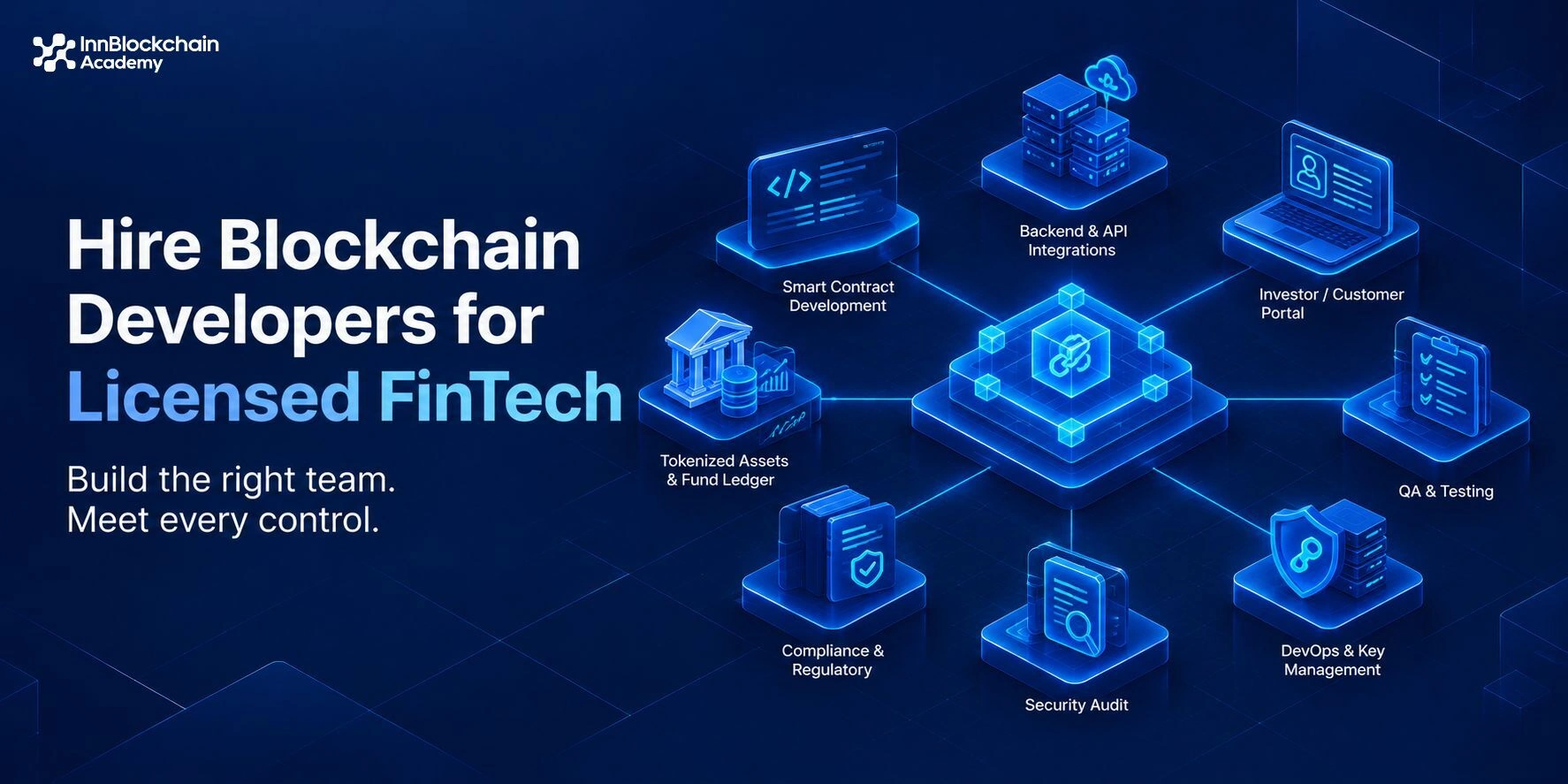
A licensed firm's blockchain platform is mostly regulated work, such as fund administration, payments or custody, built around the blockchain. The roles follow from that. The table shows what each role owns, why a licensed firm needs it, and whether it is mainly a build role or a permanent one.
| Role | What it owns | Why a licensed firm needs it | Build or run |
|---|---|---|---|
| Engineering lead or delivery manager | The team, the plan and its priorities, coordination with regulated counterparties (administrator, depositary or custodian, payment or KYC provider), the auditor and counsel, and release sign-off | Every release touches regulated counterparties and the audit, so someone has to decide the order of work and sign off each release | Build and run |
| Smart contract engineer | The smart contracts: the token or payment logic, the compliance modules, and contracts such as subscriptions or distributions | The rules the contracts enforce come from the firm's license and product terms, and each one has to map to code an auditor can check | Mostly build, with a smaller run role for upgrades |
| Backend and integration engineer | Connections to the administrator, depositary or custodian, transfer agent, KYC provider, banking partners and payment rails | The chain is a small part of the firm's operations, and most integrations are with regulated counterparties | Build and run |
| Frontend engineer | Customer or investor portal, and operations tools | Customers need to see holdings, documents and restrictions. Operations staff need to run the register or ledger | Build, then maintenance |
| QA and test engineer | Test suites for compliance logic as well as functions | A transfer that should have been refused is a compliance failure, not just a bug | Build and every release |
| DevOps, SRE and key management | Deployment, monitoring, node infrastructure, signing keys and multi-signature procedures | Keys that can freeze, force-transfer or upgrade are the most sensitive controls in the system | Build and run |
| Security engineer | Internal review, threat modeling, audit preparation and remediation | Internal review catches the basic issues first, so the external audit can focus on the serious ones | Build and every significant change |
| Compliance-engineering lead | Turning obligations into a specification, and a map showing which control in the code covers each rule | Someone has to translate between compliance, counsel and engineering, in both directions | Build, then change control |
The engineering lead does not have to be a new hire.
In a smaller firm, the CTO or the senior smart contract engineer can take on the role. Whoever does it needs proper time for the job. Alongside the lead, you need a product owner who decides what the platform must do. This is usually someone you already employ in fund, payments or securities operations.
Two roles on that list are the hardest to fill.
A compliance-engineering lead combines regulatory literacy with enough engineering to write a specification, a combination that is hard to find. A security engineer with smart contract audit experience is a narrow specialism.
Two things cannot be in-house, whatever you hire.
If your board, offering or regulator expects an independent audit, it has to come from an outside firm that did not write the code. And the product's legal classification, such as whether a token is a security or a crypto-asset, is a question for counsel. An in-house team reduces your reliance on an external developer. You will still pay some outside firms.
What should you look for when hiring?
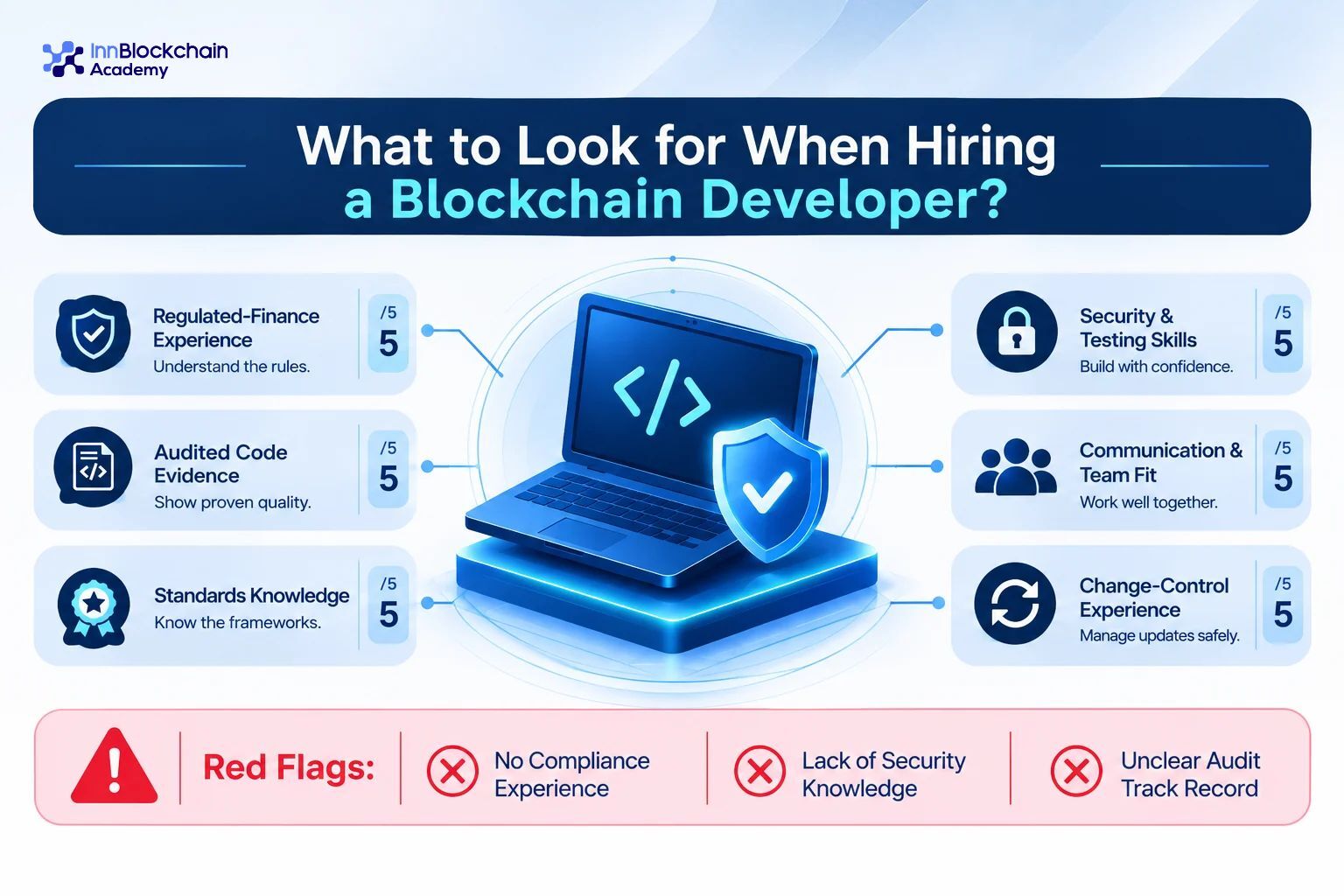
A strong smart contract CV or résumé is not enough. At a licensed firm, every hire has to understand the rules the platform enforces as well as the code that enforces them. These are the checks that separate a regulated-finance hire from a general blockchain one.
| Role | Look for |
|---|---|
| Engineering lead or delivery manager | Has taken a team through an external audit or a regulated release. Has worked with outside counterparties to a deadline |
| Smart contract engineer | Contracts they shipped that passed an external audit. Experience with the standards your product uses, such as ERC-3643 or the ERC-1400 family for tokenized securities. Access control and upgrade patterns |
| Backend and integration engineer | Integrations with regulated counterparties: custodians, fund administrators, KYC providers, banking partners, payment rails. Reconciling an off-chain record with an on-chain one. Keeping personal data off-chain |
| Frontend engineer | Customer- or investor-facing financial apps. Showing holdings, documents and restrictions clearly. Wallet connection |
| QA and test engineer | Testing rules as well as functions: refusal paths, edge cases, and automated tests that throw many random inputs at the code (fuzz or property-based testing) |
| DevOps, SRE and key management | Multi-signature setups, hardware security modules or MPC custody, key rotation and recovery procedures, node monitoring |
| Security engineer | Smart contract audit or audit-contest experience. Threat modeling. Findings written so a developer can act on them |
| Compliance-engineering lead | Has worked inside a regulated firm and alongside engineers. Can turn an obligation into a requirement someone can build and test |
Three checks for every hire:
- Regulated experience over crypto-only experience. Protocol work rewards speed and openness. A licensed platform rewards control, records and sign-offs. Ask what they have built where a compliance team, an auditor or a regulator checked the result.
- Evidence, not claims. Audited code, public repositories, or audit reports they can share with their client's permission.
- Comfort with change control. A licensed firm documents and approves every change before it ships. Someone who has only shipped fast may find that slow, and may work around it.
Red flags: a candidate who cannot explain what their code does when a rule says no, treats compliance as someone else's job, or calls an internal code review an audit.
Where do you find these developers?
Not on general job boards alone. These tend to work better for regulated hires:
- Specialist recruiters for regulated finance or blockchain.
- Audit-contest platforms such as Code4rena and Sherlock, where findings are public.
- Open-source contributors to the standards your product uses.
- Referrals from your auditor, custodian or other regulated partners.
- Engineers already in regulated finance who know change control.
How do you assess candidates?
Look at work, not just answers:
- Review shipped code, ideally with its audit report.
- Set a short paid exercise close to the real job, for example: "Which tests prove that a transfer that should be refused is always refused?"
- Bring in a reviewer. Your security engineer or an external auditor should sit in on the technical round.
- For the compliance-engineering lead, run a working session with your compliance team. Ask them to take one eligibility or anti-money-laundering rule and turn it into something a developer can build and a tester can check.
- Take references from someone who reviewed their work, such as an auditor or a compliance officer.
What do these roles cost in the EU and US?
This is where most cost guides go wrong, so we will be specific about the data.
There is no official salary series for blockchain developers in either region. Eurostat's earnings survey does not break out software developers, let alone smart contract engineers, and national statistics offices publish occupational pay at a level too broad for this purpose. The US Bureau of Labor Statistics (BLS) publishes national wages for broad occupations such as software developers, but not for smart contract engineers. Beyond that, what exists is recruiter salary guides for general engineering roles, self-reported compensation sites, and blockchain job boards.
The general engineering figures are the more reliable starting point.
| Role | EU | US |
|---|---|---|
| Software engineer | €70,000–€90,000 (5+ years, Dublin) | $135,980 median (software developer) |
| DevOps / SRE | €80,000–€120,000 (5+ years, Dublin) | $99,130 median (closest match: network and computer systems administrator) |
| Security engineer | €80,000–€100,000 (5+ years, Dublin) | $129,180 median (information security analyst) |
| QA and test engineer | €65,000–€80,000 (automation QA, 5+ years, Ireland) | $104,300 median (software QA analyst and tester) |
| Frontend engineer | No sourced figure | $92,650 median (closest match: web developer) |
| Compliance | €95,000–€110,000 (compliance manager, 5+ years, Dublin) | $80,730 median (compliance officer) |
| Senior software engineer, total pay | About €125,000 median (Amsterdam) | $255,000 median (New York City area) |
Sources: EU from Morgan McKinley's 2026 Ireland salary guide, and HERO Recruitment's IT salary guide (updated 4 August 2026) for QA. US from the Bureau of Labor Statistics, national medians for May 2025. Total pay rows from Levels.fyi (Amsterdam, 633 salaries, updated 17 November 2026; New York, 3,027 salaries, updated 16 November 2026).
Read the caveats before using any of these.
The recruiter guides state ranges without a published method. The BLS figures are national medians across all experience levels and industries, so a senior hire in a financial center will cost more. BLS has no DevOps or frontend category, so the network administrator and web developer rows are the closest matches, not exact ones. The Levels.fyi figures are total compensation (base, bonus and equity), self-reported, and weighted toward large technology employers, so they sit above what most financial firms pay in base salary. Use all of them to set a range, not a number.
Blockchain-specific figures are weaker still.
The salary pages we found for Solidity developers are built from job advertisements or third-party job-board data, and do not publish a sample size. One reported a Portugal median of €46,000 for a Solidity developer, €63,000 at senior level and €80,000 at lead level, and describes its local employer data as thin (Paymetric Labs, 2026 data). We do not budget from these, and we suggest you do not either. Treat US blockchain salary sites with the same caution: check that they publish a method and a sample size before you use them. Anyone quoting a precise blockchain salary, EU or US, should be asked for their source and method.
The practical method:
Take the senior software engineer range for your own city, in the EU or the US, add a premium you test against two or three real candidates, and treat the result as a hypothesis until you have made an offer. No public source we found measures the premium for blockchain experience reliably.
What sits on top of salary?
Gross salary is the first layer. Employer contributions come next, and your payroll provider can give you the real rate at your salary bands. Four more layers sit on top.
Recruitment
EU. Agency fees in Europe typically run at 15% to 30% of first-year salary, and 18% to 25% for IT roles in Germany and France (Hiring Hub, updated 27 April 2025; a recruitment marketplace reporting what it typically sees, not a survey).
US. Contingency fees run at 15% to 25% of first-year base salary, most often 18% to 22% for general software engineering and 25% to 30% for security roles (TechHiringCost, last updated 7 April 2026; a hiring-cost site with affiliate partners, not a survey).
For a team of seven or eight, that is a meaningful one-off cost even if only some roles go through agencies.
Benefits and equipment
Health cover, pension top-ups, hardware and software licenses, per person, per year. They follow your HR policy, which is the right source for the number.
Tooling, infrastructure and training
Node infrastructure or providers, monitoring, security tooling, test environments, and the time for a team new to regulated blockchain products to learn the domain. We have not found a public, dated source for typical amounts, so we do not give one. Your own vendors' price lists are the right source.
Management and retention
Someone has to hire, manage and keep this team, and specialists in a small market get approached often. The cost of a resignation mid-build is not only the replacement fee. It is the lost months of context on a codebase where each rule maps to an obligation.
Adding it up for one hire
Take a software engineer with five or more years' experience in Dublin at the midpoint of Morgan McKinley's 2026 range, €80,000. Add your employer contributions at that salary, which your payroll provider can give you. A 15% to 30% agency fee adds €12,000 to €24,000 once. In the US, a software developer at the BLS median of $135,980 with a 15% to 25% fee adds about $20,400 to $34,000 once. That is one role, at one mid-range figure, before the first line of code. Run the same sum for every role on the team, then multiply by the months to first release.
Why is time the cost nobody budgets?
The salary line is visible in a budget. The time cost is not, and on a regulated build it is often the larger number.
Hiring happens before building.
Every role has to be found, offered and onboarded before the work it owns can start, and the critical path runs through the hardest roles to fill. We have not found a reliable, current public figure for time-to-hire for blockchain roles in the EU or the US, so measure your own: how long did your last three senior engineering hires take, from approval to first day?
The pool is not growing.
Electric Capital's developer data, as reported by CoinDesk on 12 March 2026, put monthly active crypto developers at about 31,000 at the 2022 peak and about 23,600 in 2024. CoinDesk adds estimates of around 18,000 by mid-2025. Those are global figures and include developers with no interest in regulated finance. The subset with smart contract experience and an understanding of financial regulation is a small fraction of them.
And you compete for general engineers with the whole technology sector, in both regions.
In the US, the job openings rate in the information industry was 4.1% in September 2026, a preliminary figure (BLS, Job Openings and Labor Turnover Survey). In the EU, the job vacancy rate in telecommunications, computer programming and information services was 2.2% in the second quarter of 2026, against 2.0% across all industries (Eurostat). The two surveys define their industries differently, so read each against its own past rather than against each other.
Build and run need different teams.
A regulated blockchain platform needs its full team while the specification, contracts, integrations and audit are under way. Once it is live, it needs operations, monitoring, change control and the occasional new module. A team hired for the first phase is larger than the second needs. That is fine if more blockchain products are on the roadmap, and a fixed cost without a matching workload if they are not.
The audit is on the critical path either way.
An independent audit starts when the code is complete and ends when findings are fixed and re-tested. Hiring in-house does not shorten it. If a prospectus or offering document describes the platform, the audit should finish first, so the document describes code that has been checked.
When does an in-house team make sense?
The question is not whether in-house is cheaper. It is whether your firm will have enough blockchain work, for long enough, to keep a specialist team busy and current.
| In-house team | External developer | Hybrid: external build, in-house owner | |
|---|---|---|---|
| Cost structure | Fixed and recurring, from the first hire | Per project or phase | Project cost, plus one or two permanent roles |
| Who carries idle capacity | You | The developer | Mostly the developer |
| Time to start | After hiring | After contracting | After contracting, with the owner hired in parallel |
| Knowledge after launch | Stays, if the team stays | Leaves unless handover is planned | Stays with the internal owner |
| Third-party oversight | Fewer vendor contracts for the build, though node, KYC and custody providers remain | The developer is a third-party service provider. In the EU, for a firm within DORA, that means contract terms, a register entry and, where the service supports a critical or important function, an exit plan (Arts 28(3), 28(8), 30). In the US, a bank applies the 2023 interagency third-party guidance, and an SEC-registered firm applies Regulation S-P's service-provider oversight | As for an external developer, plus a clear handover point |
| Independent audit | Still external | Still external | Still external |
In-house fits a firm with a roadmap of several blockchain products, where the platform is a core capability, and where it can pay to keep specialists engaged between launches.
An external developer fits a firm with one product or an uncertain pipeline, where the priority is an audited first release and fixed costs need to stay low.
The hybrid fits a firm that wants the platform knowledge to stay in-house without carrying a full team: an external build, with one internal owner who sits in the specification and audit work and takes over change control afterwards. Whatever the model, plan the handover before the build starts: code ownership, documentation, the map of which control covers each rule, and who holds the keys.
For EU and US
In the EU, for a firm within DORA, an external developer brings contract and register duties under the Digital Operational Resilience Act (Regulation (EU) 2022/2554).
In the US there is no single equivalent. Banks follow the federal banking agencies' 2023 Interagency Guidance on Third-Party Relationships: Risk Management, which covers planning, due diligence, contract negotiation, ongoing monitoring and termination. For SEC-registered investment advisers, broker-dealers, investment companies and transfer agents, the duty is narrower: the SEC's 2024 amendments to Regulation S-P require written policies for overseeing service providers, through due diligence and monitoring, and service providers must notify the firm within 72 hours of a security breach affecting customer information. Larger firms had to comply by 3 December 2025 and smaller ones by 3 June 2026. A wider SEC outsourcing rule for advisers, proposed in 2022, was withdrawn in June 2025. Other licensed firms should check what vendor oversight their own regulator expects. For the separate question of owning a platform versus licensing one, see our own vs license comparison.
What about contractors, freelancers or a dedicated team?
They sit between hiring and an external build. You can start in weeks rather than months, and pay only while the work lasts. But you still manage the work, own the specification and carry the oversight: a contractor or agency can count as a service provider you have to document and monitor under DORA or Regulation S-P. A dedicated team from an agency is usually billed for time, not for a delivered platform, so the outcome stays your responsibility. Knowledge leaves when the contract ends unless the handover is written into it.
Can we retrain our own engineers?
Partly. Backend, frontend and DevOps engineers who already know your systems can learn the blockchain side of their role, and their knowledge of your systems is hard to hire. Smart contract security and the compliance-engineering lead are different: a mistake there is an exploit or a compliance failure, and neither skill is quick to learn on a deadline. Retrain where the risk is low, and hire or contract the rest.
Where to go from here
If the in-house number works for your roadmap, the hiring order matters: the engineering lead, the compliance-engineering lead and a senior smart contract engineer first. The lead owns the plan, and the other two write the specification everyone else builds against. If the number does not work, or the roadmap is one product, an external build with an internal owner is the model to price.
If you are weighing an external build for a tokenization platform. Our tokenization development for authorized firms covers the token, the register, the compliance modules, investor and issuer tooling, the independent audit, and handover to your team. To compare it with your in-house model on the same terms, book an architecture review. We will ask about the instrument, the offer route, your integrations and which roles you plan to keep in-house.
Related reading. Fund tokenization for licensed asset managers for what the platform has to do under the EU fund regimes.
This is engineering and cost commentary, not legal, tax or employment advice. Employer contribution rates, ceilings and the regulatory duties that attach to a vendor relationship depend on your firm and its country or state, so confirm them with your payroll provider and counsel.
Frequently asked questions
How much does it cost to hire blockchain developers for a licensed FinTech?
There is no reliable public salary series for blockchain roles in the EU or the US. Start from senior software engineering ranges in your city, add employer contributions and recruitment fees, then multiply across the seven or eight roles a licensed platform needs.
Which roles does a licensed blockchain team need?
An engineering lead, smart contract engineering, backend and integration, frontend, QA and testing, DevOps and key management, security review, and a compliance-engineering lead who turns obligations into a specification. The independent audit and legal classification come from outside the firm either way.
What should we look for when hiring blockchain developers for a licensed firm?
Audited code the candidate can show, experience with the standards your product uses (such as ERC-3643 for tokenized securities), and work in a regulated setting where a compliance team or auditor checked the result. For the compliance-engineering lead, look for someone who can turn an obligation into a requirement a developer can build and a tester can check.
Is there a shortage of blockchain developers?
Global monthly active crypto developers fell from about 31,000 at the 2022 peak to about 23,600 in 2024, according to Electric Capital data reported by CoinDesk. The subset with financial-regulation experience is far smaller.
Can an in-house team replace an external smart contract audit?
No. An audit by the team that wrote the code is not independent. An internal security engineer makes the external audit more productive, but the audit itself has to come from a separate firm.
Is it cheaper to build in-house or use an external developer?
It depends on the pipeline. In-house is a fixed, recurring cost that pays off across several products. An external developer is a project cost that suits one product or an uncertain roadmap. A hybrid keeps one internal owner alongside an external build.
Does DORA apply if we build in-house?
DORA applies to the firm because of its authorization, whoever builds the platform. Building in-house reduces the number of ICT service contracts for the build itself. Node, KYC and custody providers usually remain third parties that go in the register. In the US, a bank faces the same point under the 2023 interagency third-party guidance, and an SEC-registered firm under Regulation S-P, which requires oversight of service providers and a breach notice from them within 72 hours.