
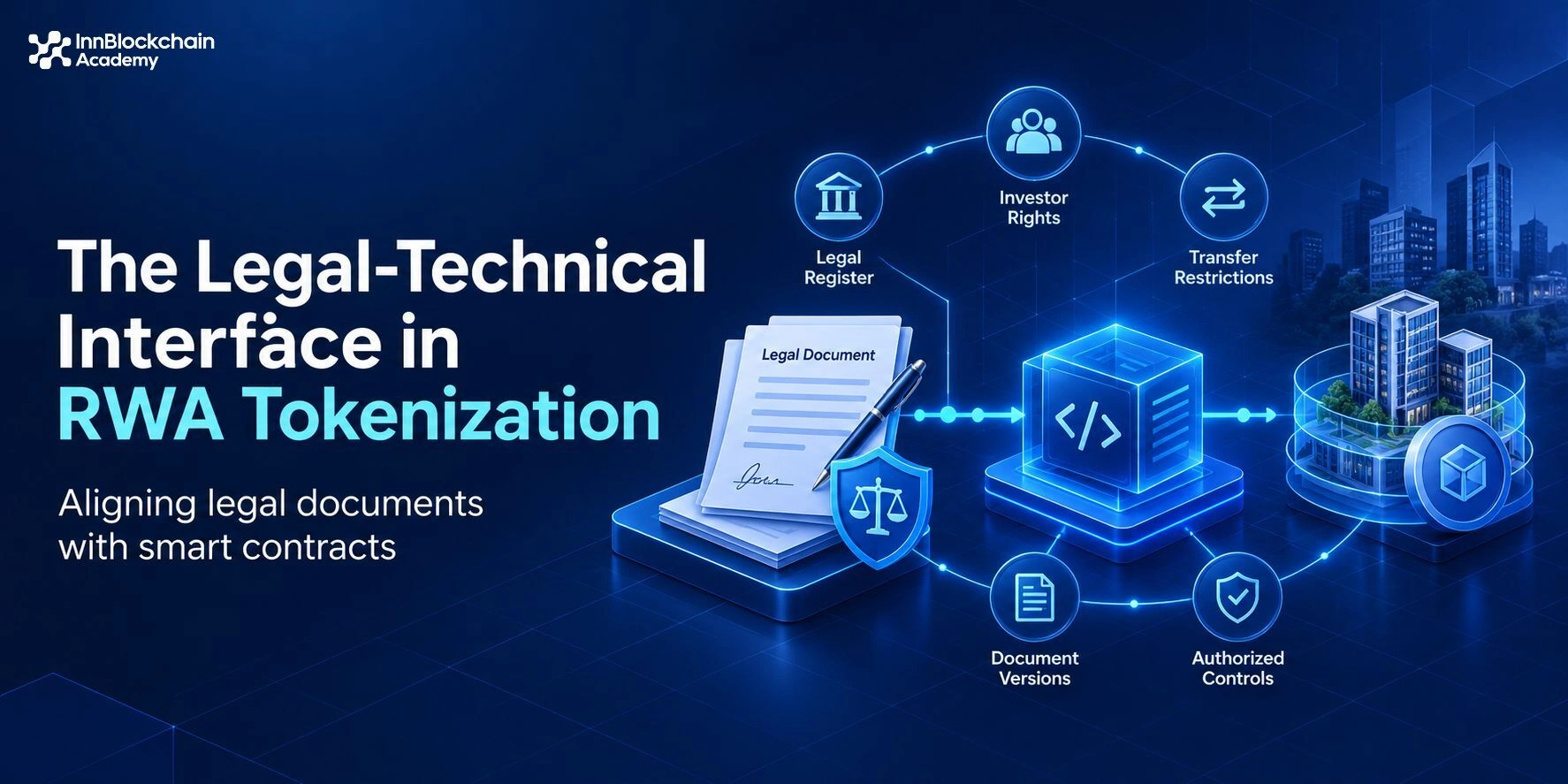
When an asset tokenization goes wrong, it rarely goes wrong in the code alone or in the documents alone. It goes wrong in the gap between them. The legal documents promise investors a right, but the code has no way to deliver it. The code blocks a sale that the law says must be allowed. The ledger (blockchain) and the share register (official list of owners) show different people, and nobody decided which one counts.
In short: a tokenized asset's legal documents set the rights, restrictions and powers; the smart contract can carry them out, but it cannot create them. Those documents (the articles or note terms, the subscription agreement, the offering document) stay in force. In most asset tokenizations the token moves securities issued by an SPV, not the land title. Which record counts when a token moves, the ledger or the legal register, is set by national law and your documents.
The reason is structural. Your lawyer writes in obligations and conditions. Your engineer writes in functions and parameters. Each assumes the other has handled the translation, and in most projects nobody is assigned to it. This guide names the five points where that translation happens, says who should decide each one, and lists what each side needs from the other before work starts.
Who this is for.
Owners of real estate, private credit, vehicles, equipment and other assets who are tokenizing with a legal team and an engineering team, whether those are two firms or one. It is written for the stage after you have picked the legal setup that issues the tokens (usually a company or a special purpose vehicle, SPV) and before you tell developers what to build. It uses EU rules as the worked example. If you have not chosen the legal setup yet, start with how to tokenize real-world assets. If you are not sure your token is a security at all, settle that first with MiCA or MiFID II. Not every hand-off below applies to every project; each section opens with when it does.
Short on time? Here's the gist
What is the legal-technical interface, and where does it break?
Applies to every tokenization of an asset.
The interface is the set of points where a legal decision becomes a contract setting, or where a contract behavior needs a legal basis. It runs in both directions:
- Law to code. The documents decide what the holder owns, who may hold it and when it may move. The contract has to implement those decisions faithfully.
- Code to law. The contract gives someone powers to freeze a wallet, force a transfer, pause the token, upgrade the logic. The documents have to authorize those powers, name who holds them and say what investors can expect.
Five hand-off points carry almost all the risk.
| Hand-off | Who decides | What the engineer needs | What breaks if it is skipped |
|---|---|---|---|
| 1. What the token gives the holder | Lawyer | A list of rights, one by one | The contract pays out, or refuses, without a legal basis |
| 2. Whether the ledger is the register | Lawyer, with local counsel | A statement of which record is authoritative | Two records drift, and nobody can say which one is right |
| 3. Who may hold it, and when it may move | Lawyer | Each restriction, with its source and scope | The gate blocks lawful transfers or lets forbidden ones through |
| 4. Which documents the token points to | Lawyer | The list of governing documents and how versions apply | Investors cannot tell which terms they hold |
| 5. Who can override the contract | Engineer proposes, lawyer authorizes | The powers the documents allow, and who may use them | An admin key acts on investors' property with no basis |
The sections below take each in turn. What a smart contract can and cannot enforce in court is a separate question, covered in how to tokenize real-world assets. This guide is about getting the two sides to agree before the code exists.
Hand-off 1: what does the token actually give the holder?
Applies to every tokenization. The structure decides the instrument; this hand-off decides how each of its rights is carried.
Your lawyer chooses the instrument: a share in the SPV, a note it issues, a unit in a vehicle. That choice sets the holder's rights, and they live in the company's articles, the note terms or the vehicle's rules. The token is how those rights are recorded and moved. It is not where they come from.
So the first hand-off is a rights map: each right the documents grant, and how it is carried.
| Right in the documents | Carried on-chain | Carried off-chain | The question to settle |
|---|---|---|---|
| Distributions or interest | Calculated from the holder list at a record date, then paid | The entitlement itself, the record-date rule, tax withholding | Who tells the contract how much to pay, and what happens to payments for holders who fail a check |
| Redemption or repayment at maturity | Tokens burned against payment | The redemption terms and any conditions | What the contract does if the money is not there on the day |
| Voting | Holder snapshot, sometimes the vote itself | Meeting rules, quorum, how the result binds the company | Whether an on-chain vote is legally a vote, or an indication |
| Information | Hashes of reports and notices | The reports themselves | Which documents investors are entitled to, and when |
| Pre-emption, consent or tag-along on a sale | Often enforced in the transfer check | The rule and its exceptions | Whether the contract enforces it, or only flags it |
| Liquidation proceeds | Final distribution and burn | The insolvency or winding-up process | Who tells the contract the process has ended |
Two rules make this map work.
The contract implements, it never decides.
If the contract pays a distribution the documents do not provide for, the payment has no legal basis. If it refuses one the documents do provide for, the issuer is in breach. A right that exists only in code is a liability for the issuer, not a feature.
The documents and the contract must say the same thing.
In the EU, for example, where a prospectus is required, it must contain the information material to an investor about the rights attaching to the securities (Prospectus Regulation Art 6(1)(b)). So if the prospectus says one thing and the code does another, it is not just an engineering bug. Investors have been told something untrue about their rights, which is a disclosure problem.
Hand-off 2: is the ledger the legal register, or a copy of it?
Applies whenever investors' holdings are recorded on a blockchain, which is every tokenization. How much it matters depends on whether the ledger is meant to carry legal title.
Whether a blockchain entry can itself be legal title to a security, rather than evidence of title recorded somewhere else, is decided by national civil law in the country where the security is issued. In the EU, for example, this is left to each Member State, and some have passed laws that let a distributed-ledger register carry title. Germany's electronic securities law (eWpG), France's DEEP framework and Luxembourg's blockchain laws are the best-known. Where no such law applies, the company's share register or the note register stays the legal record, and the ledger mirrors it.
Your lawyer, with local counsel, answers whether it can be the register. Your documents then have to say whether it is, and the engineer builds a different system for each answer.
| The ledger is the register | The ledger mirrors the register | |
|---|---|---|
| A transfer on-chain | Moves legal title | Triggers an update to the legal record |
| The engineer builds | The correction, recovery and record-keeping the registry law demands | A reconciliation between two records, run on a schedule |
| The documents should say | How errors are corrected and lost keys handled under that law | Which record wins when they disagree |
| The main risk | The ledger falls short of what the law requires of a register | The two records drift apart unnoticed |
Admission to trading adds a second question.
Holders transferring tokens on your contract is not, by itself, trading on a venue. But once your securities are admitted to trading or traded on a regulated market, MTF or OTF run by an authorized operator, CSDR reaches you as the issuer. In the EU, for example, an issuer whose transferable securities are admitted to trading or traded on a trading venue must arrange for them to be represented in book-entry form (CSDR Art 3(1)). That duty is yours even though you run no venue and hold no depository licence. Recording the venue's trades at a central securities depository (Art 3(2)), or relying on a DLT Pilot exemption, is for the venue and its settlement system.
The question it leaves you is whether your ledger entry counts as book-entry form under national law, or whether the issue must also be recorded at a depository. If admission is on your roadmap, settle it before the build.
Lost keys are where this decision matters most.
If the ledger is the register and a holder loses their private key, do they lose title to the holding, or only access to it? The registry law and your documents decide. If the ledger mirrors a register, title stays with the holder the register records, and the token can be moved to a new wallet to match. Either way, the contract needs a recovery path that follows that answer, and no broader power than the documents grant.
Hand-off 3: who may hold the token, and when may it move?
Applies if any restriction limits who can hold the token or when it can be transferred. For a security sold to selected investors, that is nearly always.
Restrictions arrive from several sources, and the engineer cannot tell them apart unless the lawyer labels them.
| Source of the restriction | Example | Where it comes from |
|---|---|---|
| The offer route | In the EU, for example: qualified investors only; fewer than 150 non-qualified investors per Member State; a €100,000 minimum | Prospectus Regulation Art 1(4)(a), (b), (c) and (d), when the offer relies on one of those exemptions |
| Company law and the articles | Pre-emption rights, board consent, drag-along and tag-along | The SPV's articles or shareholders' agreement |
| The deal documents | Lock-ups, holding limits, a ban on transfers to competitors | The note terms or subscription agreement |
| Investor checks | Identity verified, not on a sanctions list, eligible in their country | The checks your distributors and providers run |
| Market rules, once admitted | In the EU, for example: no dealing by managers during closed periods | The Market Abuse Regulation, Art 19(11), once the token is admitted to trading on a venue run by an authorized operator |
What does the engineer need from the lawyer for each restriction?
For each restriction, the engineer needs three things from the lawyer: the rule, its source, and its scope. Scope, meaning exactly when and to whom the rule applies, is the one most often left out. Take a qualified-investors-only rule. Does it apply only when investors first subscribe, or also every time a holder later transfers the token? Does it check only the investor receiving the token, or the one sending it too? If the documents do not say, the engineer has to guess, and either wrong guess causes a problem. Set the scope too narrow, and transfers the documents forbid go through. Set it too broad, and holders are blocked from transfers the documents allow.
Where each restriction then lives in the contract (on the transfer check, on the subscription path, or off-chain) is an engineering decision. The transfer gate for EU tokenized securities covers it in depth, including the controls that look as if they belong on the gate and do not.
Restrictions also have to give way.
In cases such as inheritance, a court order or an insolvency administrator taking control, the law sometimes requires a transfer that every restriction in the contract would block. The documents should say how that transfer happens and who triggers it. Otherwise, the first time it is needed, the issuer has to choose between breaching the documents and ignoring a court.
Hand-off 4: which legal documents does the tokenized asset point to, and what does a new version mean?
Applies if the token contract records which legal documents govern it. We build this pattern for every security token.
The common pattern is to store a fingerprint (a hash) of each governing document in the contract, so anyone can check that the document they hold is the one the issuer pointed to. We build this for the articles or note terms, the subscription terms and any offering document.
A hash proves that a particular document existed in that exact form and that the issuer pointed to it. It does not prove the document is valid, signed or binding. That is still the lawyer's job.
The lawyer's side of this hand-off is a list, and a rule about versions:
- Which documents govern the token. Not every document in the data room, only the ones a holder's rights depend on.
- What a new version means. A revised note term may bind every holder, or only new subscribers. A new version of an offering document may change nothing for existing holders, or it may give recent subscribers a right to withdraw.
This is not hypothetical. Take an offer made under a prospectus in the EU. If something significant comes up before the offer closes (a new factor, a material mistake or a material inaccuracy), the issuer must publish a supplement, an approved update to the prospectus (Prospectus Regulation Art 23(1)). Investors who had already agreed to subscribe then have three working days from its publication to withdraw (Art 23(2)). The contract has to leave room for that. If it issues tokens the moment an investor commits, nothing is left pending for a withdrawal to cancel. So a new document version is not only a paperwork change: it affects when subscriptions can safely settle.
How we anchor documents, and why a new version means something different under each regime, is covered in document anchoring for tokenized securities. One rule from it belongs here: personal data never goes on-chain, because a ledger cannot erase it and investors have a right to erasure under the GDPR (Art 17). The lawyer, the data protection lead and the engineer decide together what is anchored.
Hand-off 5: who can override the contract, and do the documents say so?
Applies to every token with an administrator, agent or upgrade path, which in practice means nearly every security token.
A security token is not a free-floating crypto-asset. Somebody needs to be able to act when the real world changes. That means the contract carries powers:
| Power | Why it exists | What the documents should say |
|---|---|---|
| Freeze a wallet | Sanctions, a court order, a suspected compromise | Who may freeze, on what grounds, and how a holder can contest it |
| Forced transfer | Inheritance, court orders, lost-key recovery | When it may be used, by whom, and on what evidence |
| Pause the token | A defect, an incident, a corporate event | Who can pause, for how long, and what investors are told |
| Upgrade the logic | A defect, or a change in the rules | Whether upgrades need investor consent, and what may never change |
| Mint and burn | Subscriptions, redemptions, maturity | That supply moves only against the documented events |
Every one of these is a power over investors' property.
If the contract carries a power the documents do not authorize, it is simply an admin key: whoever controls it can move investors' holdings with no legal basis, and the first time it is used, the issuer has to justify it after the fact. If the documents authorize it, the same power becomes a disclosed one: investors know in advance when it may be used, who may use it, and that each use is recorded.
The engineer's job is to make sure the contract can do no more than the clause allows. In our builds, that means three controls. Each power sits with a separate role, so no single key holds them all. Anything that moves holdings needs multi-signature approval, so several people must sign before it runs. Upgrades go through a time delay, so anyone can see a change before it takes effect. None of these is a regulatory requirement. Each one is how we keep what the code can do within what the documents allow.
Off-chain events need a messenger.
A loan default, a court order, a death, the end of a winding-up: none of these is visible to a contract. For each one, the documents should name who signals it to the contract and on what evidence, and the contract should accept that signal only from that role. In the EU, for example, where a prospectus applies, these powers and their risks are part of what investors read. Its risk factors must be limited to risks that are specific to the issuer or the securities and material to an investment decision, not generic ones (Prospectus Regulation Art 16(1)).
Who owns the translation?
Applies to every project, whether your lawyer and engineer sit in two firms or one.
The fix is not another meeting. It is one document both sides sign: a map of every clause that touches the token, the contract function or parameter that carries it, who can change it, and what happens if the two disagree.
We work in this order, because each step depends on the one before it:
- Structure: the lawyer picks the issuing entity and the instrument.
- Classification: the lawyer confirms whether the token is a financial instrument, and if so, in which category.
- Rights map: both sides sign off (hand-off 1).
- Register status: the lawyer decides, with local counsel (hand-off 2).
- Restrictions list: the lawyer gives each rule with source and scope; the engineer decides where it lives (hand-off 3).
- Override powers: the engineer proposes, the lawyer writes them into the documents (hand-off 5).
- Anchoring list and version rule: the lawyer sets them last, because the anchored documents need to already include the override clauses (hand-off 4).
- Independent audit: the auditor tests the contract against the map, not only against itself.
The conflict clause is the single most useful line in the map. Somewhere the documents should say which record prevails when the ledger and the legal register disagree. Your lawyer picks the answer. The engineer then knows whether to build a reconciliation, a correction path, or both.
If your legal team can settle all five hand-offs on paper, the build starts from a specification instead of from assumptions.
What this does not fix
- Tokenization does not make a weak structure enforceable. If the SPV or the note terms fail in court, the contract faithfully executing them does not help.
- No regulation requires a particular token standard. We build with permissioned standards such as ERC-3643 because they carry identity and transfer controls well, not because any rule names them.
- We are engineers, not your lawyers. We build to the map your counsel signs, and we flag where the map is silent. National-law questions need local counsel.
Where to go from here
The legal documents decide what your investors own. The contract decides what actually happens to it. The five hand-offs are where those two either agree on paper before launch, or disagree in production after it. For your compliance team, the signed map is also the record that shows every power in the contract has a clause behind it.
If you are ready to brief a build. Our RWA tokenization development covers the token, the investor register, onboarding, distributions and the independent audit, built to the map your counsel signs. To walk through the five hand-offs against your own structure, book a call. Cost and timeline depend on the rights the token carries, the register model and the restrictions it enforces, and we give both once those are settled.
If you are earlier than that. How to tokenize real-world assets walks through structure, token, onboarding and distribution in order, and which EU rules apply to a tokenized security maps the obligations that follow.
This is engineering commentary on regulatory requirements, not legal advice. How your documents allocate rights, powers and register status needs sign-off from counsel, including local counsel where national law decides the answer.
Frequently asked questions
Can a smart contract replace the legal documents in a tokenization?
No. The legal documents create the holder's rights; the contract records and carries them out. A right that exists only in code has no legal basis, and a contract that disagrees with the documents creates a dispute rather than settling one. The two have to be designed together.
Can a smart contract transfer legal ownership of real estate?
Usually not directly. In the structure most tokenizations use, an SPV owns the property and the token represents shares or notes issued by that SPV. The token moves those securities; the land title stays registered to the SPV in the land registry. Whether a token transfer itself moves legal title to the securities depends on whether the ledger is the legal register.
What legal docs do I still need if my asset is tokenized on-chain?
Tokenized asset legal documents are the same ones a conventional issue needs: the SPV's articles or shareholders' agreement, the terms of the instrument, the subscription agreement, and an offering document (a prospectus where one is required, or often a private placement memorandum where the offer is exempt). Tokenization adds clauses to them: which record prevails, the override powers and who may use them, and the version rule. The token replaces none of them.
What happens off-chain when an RWA token transfers on-chain?
It depends on the register model. If the ledger mirrors a register, the off-chain register has to be updated to match, and legal ownership follows that register. If the ledger is the legal register, the transfer itself moves legal title. Either way, the issuer's investor records, such as onboarding files and payment details, have to stay in step.
Can the issuer freeze or move investors' tokens?
Technically, most security tokens allow it, because sanctions, court orders and lost keys make it necessary. Legally, the power should exist only where the documents authorize it, name who may use it and set conditions. A power with no clause behind it is a liability.
What happens if an investor loses their private key?
It depends on the register model and your documents. If the ledger mirrors a register, the investor still holds title because the register records it, and the token can be moved to a new wallet after their identity is re-verified. If the ledger is the legal register, the registry law and your documents decide whether the holder loses title or only access. Either way, the documents should say who approves a recovery and on what evidence.
Does a smart contract audit check the legal documents?
Not unless you ask for it. A standard smart contract audit tests the code for security flaws and checks it against its own specification. It does not check that specification against your legal documents. Give the auditor the signed map, so the audit also tests whether each function matches the clause behind it.